


Welcome to the IKCEST
Carbon emissions, energy flow charts for all U.S. states
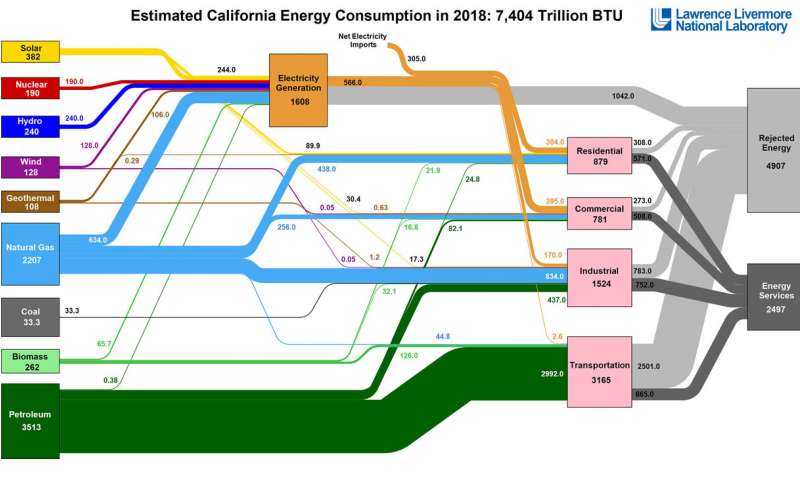
Carbon emissions, energy flow charts for all U.S. states

Carbon emissions, energy flow charts for all U.S. states
Credit: Lawrence Livermore National Laboratory

Lawrence Livermore National Laboratory (LLNL) has updated its energy flow charts to include state-by-state energy use for 2015-2018. It also has released carbon emissions charts that depict a breakdown of all 50 states' carbon emissions from 2014-2017.

Each year, LLNL releases flow charts that illustrate the nation's consumption and use of energy. This recent release represents a major update to the state-level analysis.

Carbon emissions are broken down in metric tons while energy use is broken down in BTUs (a BTU, or British Thermal Unit, is a unit of measurement for energy; 3,412 BTUs is equivalent to 1 kilowatt-hour, which is the amount of energy it takes to light an efficient LED lightbulb for a week).

Renewable energy, specifically solar and wind energy, have made huge strides in the energy supply sector contributing to the decrease in carbon emissions since 2014. In states rich in renewable resources such as Iowa, wind supplies make up well over a quarter of the state's electricity and contribute to the state's ability to export electricity to its neighbors.

Livermore's home state of California saw a 21 percent increase in from 2016 to 2017.

Texas saw dramatic reductions in by 2017 with a net decrease of 182.4 million metric tons from the levels in 2014. Meanwhile, energy use in Texas increased by 239 trillion BTUs from 2016 to 2017. Texas saw a 57 percent hike in solar energy and a 14 percent jump in compared to 2016 levels.

In New York, use dropped by 28 trillion BTUs in 2017 compared to 2016 levels. Carbon emissions dropped by 1.2 million metric tons in 2017 compared to levels in 2014. New York saw a 23 percent increase in solar use and a 5 percent increase in wind use in 2017 compared to 2016 levels.


Explore further

Americans used less energy in 2019

More information: State-by-state carbon emissions charts: flowcharts.llnl.gov/
Citation: Carbon emissions, energy flow charts for all U.S. states (2020, July 29) retrieved 29 July 2020 from https://techxplore.com/news/2020-07-carbon-emissions-energy-states.html
This document is subject to copyright. Apart from any fair dealing for the purpose of private study or research, no part may be reproduced without the written permission. The content is provided for information purposes only.

Original Text (This is the original text for your reference.)

Carbon emissions, energy flow charts for all U.S. states

Carbon emissions, energy flow charts for all U.S. states
Credit: Lawrence Livermore National Laboratory

Lawrence Livermore National Laboratory (LLNL) has updated its energy flow charts to include state-by-state energy use for 2015-2018. It also has released carbon emissions charts that depict a breakdown of all 50 states' carbon emissions from 2014-2017.

Each year, LLNL releases flow charts that illustrate the nation's consumption and use of energy. This recent release represents a major update to the state-level analysis.

Carbon emissions are broken down in metric tons while energy use is broken down in BTUs (a BTU, or British Thermal Unit, is a unit of measurement for energy; 3,412 BTUs is equivalent to 1 kilowatt-hour, which is the amount of energy it takes to light an efficient LED lightbulb for a week).

Renewable energy, specifically solar and wind energy, have made huge strides in the energy supply sector contributing to the decrease in carbon emissions since 2014. In states rich in renewable resources such as Iowa, wind supplies make up well over a quarter of the state's electricity and contribute to the state's ability to export electricity to its neighbors.

Livermore's home state of California saw a 21 percent increase in from 2016 to 2017.

Texas saw dramatic reductions in by 2017 with a net decrease of 182.4 million metric tons from the levels in 2014. Meanwhile, energy use in Texas increased by 239 trillion BTUs from 2016 to 2017. Texas saw a 57 percent hike in solar energy and a 14 percent jump in compared to 2016 levels.

In New York, use dropped by 28 trillion BTUs in 2017 compared to 2016 levels. Carbon emissions dropped by 1.2 million metric tons in 2017 compared to levels in 2014. New York saw a 23 percent increase in solar use and a 5 percent increase in wind use in 2017 compared to 2016 levels.


Explore further

Americans used less energy in 2019

More information: State-by-state carbon emissions charts: flowcharts.llnl.gov/
Citation: Carbon emissions, energy flow charts for all U.S. states (2020, July 29) retrieved 29 July 2020 from https://techxplore.com/news/2020-07-carbon-emissions-energy-states.html
This document is subject to copyright. Apart from any fair dealing for the purpose of private study or research, no part may be reproduced without the written permission. The content is provided for information purposes only.
Comments

    Something to say?

    Log in or Sign up for free

    Disclaimer: The translated content is provided by third-party translation service providers, and IKCEST shall not assume any responsibility for the accuracy and legality of the content.
    Translate engine
    Article's language
    English
    中文
    Pусск
    Français
    Español
    العربية
    Português
    Kikongo
    Dutch
    kiswahili
    هَوُسَ
    IsiZulu
    Action
    Related

    Report

    Select your report category*


    Reason*


    By pressing send, your feedback will be used to improve IKCEST. Your privacy will be protected.

    Submit
    Cancel