

Welcome to the IKCEST
DNA damage triggers reprogramming into stem cells
DNA damage triggers reprogramming into stem cells

DNA damage triggers reprogramming into stem cells
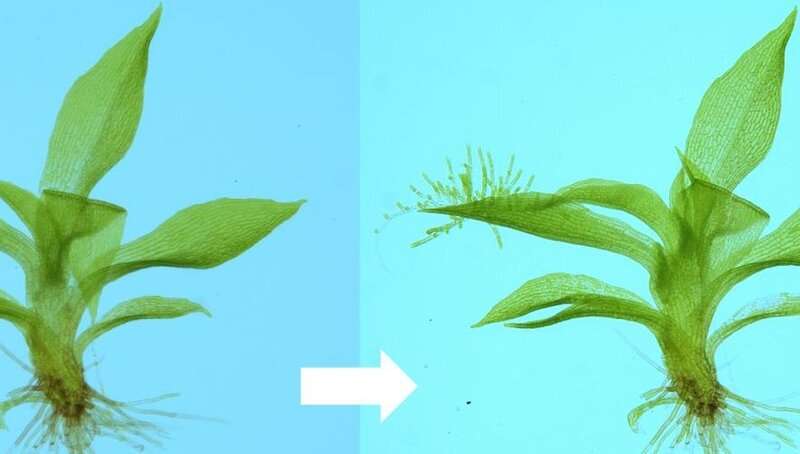
DNA damage causes cells to reprogram themselves into stem cells and regenerate new plant bodies in the moss Physcomitrella patens. Credit: NIBB

A joint research team from the National Institute for Basic Biology (NIBB) in Japan, Huazhong Agricultural University in China, and the Czech Academy of Sciences in the Czech Republic has discovered that DNA damage causes cells to reprogram themselves into stem cells and regenerate new plant bodies in the moss Physcomitrella patens. The researchers describe this phenomenon as a unique environmental adaptation of plants.

In animals, cells with severe DNA damage undergo apoptosis——and are eliminated. These new results published in Nature Plants tell a different story for moss cells. Ms. Nan Gu, a NIBB Special Inter-University Researcher who is a at Huazhong Agricultural University under the mentorship of Dr. Chunli Chen, and her collaborators discovered that when DNA of the moss is damaged, the DNA is immediately repaired. Furthermore, the cells with repaired DNA become , which can produce an entire plant body, similar to fertilized egg cells. Nan Gu says, "I was shocked by the result, because select to die, but plant cells select to produce new offspring."

After Physcomitrella plants were soaked in a DNA-damaging solution for 6 hours, their DNA was severely broken. However, the damaged DNA was repaired to almost its original state within one day. After that, the STEMIN1 gene, a master regulator of reprogramming was triggered. STEMIN1-positive cells eventually became stem cells and went on to form whole plants with stems and leaves.

"It has been known that, in plants, differentiated cells around dead cells can become stem cells. However, this is the first discovery that differentiated cells with damaged DNA themselves become stem cells," explains Dr. Yosuke Tamada, a co-first author of this study.

"This phenomenon we discovered is a strategy for environmental adaptation, especially in plants, which are not able to escape from adverse environments as quickly as animals," said Professor Mitsuyasu Hasebe from NIBB, who led the research team.


Explore further

A matter of concentration

More information: Gu, N., Tamada, Y., Imai, A. et al. DNA damage triggers reprogramming of differentiated cells into stem cells in Physcomitrella. Nat. Plants (2020). doi.org/10.1038/s41477-020-0745-9
Journal information: Nature Plants
Provided by National Institutes of Natural Sciences
Citation: DNA damage triggers reprogramming into stem cells (2020, August 17) retrieved 17 August 2020 from https://phys.org/news/2020-08-dna-triggers-reprogramming-stem-cells.html
This document is subject to copyright. Apart from any fair dealing for the purpose of private study or research, no part may be reproduced without the written permission. The content is provided for information purposes only.

Original Text (This is the original text for your reference.)

DNA damage triggers reprogramming into stem cells

DNA damage triggers reprogramming into stem cells
DNA damage causes cells to reprogram themselves into stem cells and regenerate new plant bodies in the moss Physcomitrella patens. Credit: NIBB

A joint research team from the National Institute for Basic Biology (NIBB) in Japan, Huazhong Agricultural University in China, and the Czech Academy of Sciences in the Czech Republic has discovered that DNA damage causes cells to reprogram themselves into stem cells and regenerate new plant bodies in the moss Physcomitrella patens. The researchers describe this phenomenon as a unique environmental adaptation of plants.

In animals, cells with severe DNA damage undergo apoptosis——and are eliminated. These new results published in Nature Plants tell a different story for moss cells. Ms. Nan Gu, a NIBB Special Inter-University Researcher who is a at Huazhong Agricultural University under the mentorship of Dr. Chunli Chen, and her collaborators discovered that when DNA of the moss is damaged, the DNA is immediately repaired. Furthermore, the cells with repaired DNA become , which can produce an entire plant body, similar to fertilized egg cells. Nan Gu says, "I was shocked by the result, because select to die, but plant cells select to produce new offspring."

After Physcomitrella plants were soaked in a DNA-damaging solution for 6 hours, their DNA was severely broken. However, the damaged DNA was repaired to almost its original state within one day. After that, the STEMIN1 gene, a master regulator of reprogramming was triggered. STEMIN1-positive cells eventually became stem cells and went on to form whole plants with stems and leaves.

"It has been known that, in plants, differentiated cells around dead cells can become stem cells. However, this is the first discovery that differentiated cells with damaged DNA themselves become stem cells," explains Dr. Yosuke Tamada, a co-first author of this study.

"This phenomenon we discovered is a strategy for environmental adaptation, especially in plants, which are not able to escape from adverse environments as quickly as animals," said Professor Mitsuyasu Hasebe from NIBB, who led the research team.


Explore further

A matter of concentration

More information: Gu, N., Tamada, Y., Imai, A. et al. DNA damage triggers reprogramming of differentiated cells into stem cells in Physcomitrella. Nat. Plants (2020). doi.org/10.1038/s41477-020-0745-9
Journal information: Nature Plants
Provided by National Institutes of Natural Sciences
Citation: DNA damage triggers reprogramming into stem cells (2020, August 17) retrieved 17 August 2020 from https://phys.org/news/2020-08-dna-triggers-reprogramming-stem-cells.html
This document is subject to copyright. Apart from any fair dealing for the purpose of private study or research, no part may be reproduced without the written permission. The content is provided for information purposes only.
Comments

    Something to say?

    Log in or Sign up for free

    Disclaimer: The translated content is provided by third-party translation service providers, and IKCEST shall not assume any responsibility for the accuracy and legality of the content.
    Translate engine
    Article's language
    English
    中文
    Pусск
    Français
    Español
    العربية
    Português
    Kikongo
    Dutch
    kiswahili
    هَوُسَ
    IsiZulu
    Action
    Related

    Report

    Select your report category*


    Reason*


    By pressing send, your feedback will be used to improve IKCEST. Your privacy will be protected.

    Submit
    Cancel