


Welcome to the IKCEST
Thinning Surface Layer of Ocean Leaves Waters More Susceptible to Extreme Warming Events

Ocean Heat Wave Climate Change

Marine Heatwaves Becoming More Intense, More Frequent

When thick, the surface layer of the ocean acts as a buffer to extreme marine heating—but a new study from shows this “mixed layer” is becoming shallower each year. The thinner it becomes, the easier it is to warm. The new work could explain recent extreme marine heatwaves, and points at a future of more frequent and destructive ocean warming events as global temperatures continue to climb.

“Marine heatwaves will be more intense and happen more often in the future,” said Dillon Amaya, a CIRES Visiting Fellow and lead author on the study out this week in the Bulletin of the American Meteorological Society’s Explaining Extreme Events. “And we are now understanding the mechanics of why. When the mixed layer is thin, it takes less heat to warm the ocean more.”

The mixed layer—the water in which temperature remains consistent—blankets the top 20-200 meters of the ocean. Its thickness is responsible for heat events: the thicker it is, the more the layer can act as a buffer to shield the waters below from incoming hot air. But as this armor thins, the mixed layer becomes more susceptible to rapid swings in temperature.

“Think of the mixed layer as boiling a pot of water,” said Amaya. “It will take no time at all for an inch of water to come to a boil, but much longer for a pot filled to the brim to heat through.”
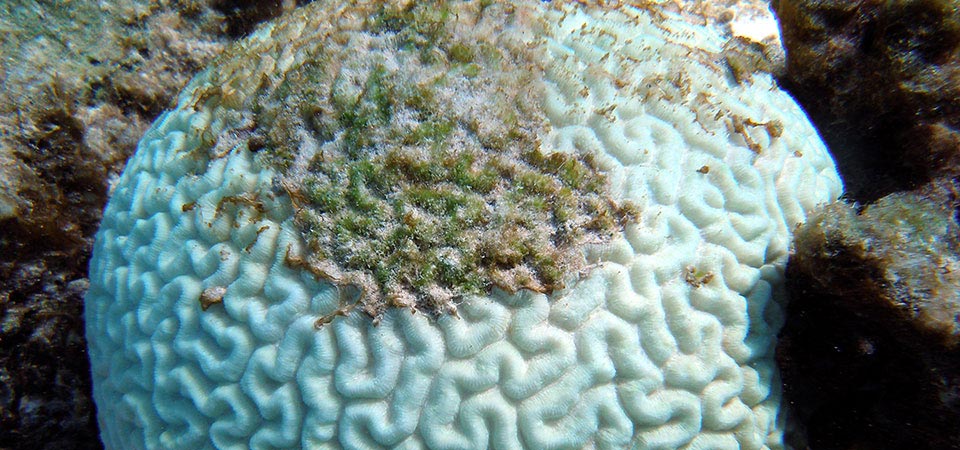
Bleached Corals

Bleached corals from warm ocean water temperatures. Credit: NOAA

Amaya and his team from NOAA, NCAR and CU Boulder used a combination of ocean observations and models to estimate the depth of the mixed layer back to 1980, and also project out into the future. They determined that over the last 40 years, the layer has thinned by nearly 3 meters (9 feet) in some regions of the North Pacific. And by 2100, the mixed layer will be 4 meters (12 feet) thinner—30 percent less than what it is today. This thin mixed layer combined with warmer global temperatures will set the stage for drastic swings in ocean temperatures, leading to much more frequent and extreme heating events, the researchers say.

And it’s already happening. Take the 2019 heatwave in the Northeast Pacific. Weakened winds and higher air temperatures came together to warm Pacific Ocean waters by about 3 degrees C (5.5 F). A thinning mixed layer most likely contributed to this surge of warm waters, the authors found. And it will get worse.

“If you take the same wind and ocean conditions that occurred in 2019 and you apply them to the estimated mixed layer in 2100, you get a marine heatwave that is 6.5 degrees C (12 F) warmer than what we say in 2019,” said Amaya. “An event like that would absolutely devastate sensitive marine ecosystems along the U.S. west coast.”

Amaya also points out that, as climate continues to warm and the mixed layer continues to thin, scientists might start to lose the ability to predict year-to-year ocean surface temperatures. Without the ability to accurately forecast ocean temperatures, fisheries and other coastal operations could be in danger.

Other studies also suggest marine heatwaves will become more common in the future, but not many have explored the root cause: ocean dynamics and physics. “In order to simulate these events in models and help predict them, we must understand the physics of why that’s happening,” said Amaya.

Reference: “Are Long-Term Changes in Mixed Layer Depth Influencing North Pacific Marine Heatwaves?” by Dillon J. Amaya, Michael A. Alexander, Antonietta Capotondi, Clara Deser, Kristopher B. Karnauskas, Arthur J. Miller and Nathan J. Mantua, 27 January 2021, Bulletin of the American Meteorological Society.
DOI: 10.1175/BAMS-D-20-0144.1


Original Text (This is the original text for your reference.)

Ocean Heat Wave Climate Change

Marine Heatwaves Becoming More Intense, More Frequent

When thick, the surface layer of the ocean acts as a buffer to extreme marine heating—but a new study from shows this “mixed layer” is becoming shallower each year. The thinner it becomes, the easier it is to warm. The new work could explain recent extreme marine heatwaves, and points at a future of more frequent and destructive ocean warming events as global temperatures continue to climb.

“Marine heatwaves will be more intense and happen more often in the future,” said Dillon Amaya, a CIRES Visiting Fellow and lead author on the study out this week in the Bulletin of the American Meteorological Society’s Explaining Extreme Events. “And we are now understanding the mechanics of why. When the mixed layer is thin, it takes less heat to warm the ocean more.”

The mixed layer—the water in which temperature remains consistent—blankets the top 20-200 meters of the ocean. Its thickness is responsible for heat events: the thicker it is, the more the layer can act as a buffer to shield the waters below from incoming hot air. But as this armor thins, the mixed layer becomes more susceptible to rapid swings in temperature.

“Think of the mixed layer as boiling a pot of water,” said Amaya. “It will take no time at all for an inch of water to come to a boil, but much longer for a pot filled to the brim to heat through.”

Bleached Corals

Bleached corals from warm ocean water temperatures. Credit: NOAA

Amaya and his team from NOAA, NCAR and CU Boulder used a combination of ocean observations and models to estimate the depth of the mixed layer back to 1980, and also project out into the future. They determined that over the last 40 years, the layer has thinned by nearly 3 meters (9 feet) in some regions of the North Pacific. And by 2100, the mixed layer will be 4 meters (12 feet) thinner—30 percent less than what it is today. This thin mixed layer combined with warmer global temperatures will set the stage for drastic swings in ocean temperatures, leading to much more frequent and extreme heating events, the researchers say.

And it’s already happening. Take the 2019 heatwave in the Northeast Pacific. Weakened winds and higher air temperatures came together to warm Pacific Ocean waters by about 3 degrees C (5.5 F). A thinning mixed layer most likely contributed to this surge of warm waters, the authors found. And it will get worse.

“If you take the same wind and ocean conditions that occurred in 2019 and you apply them to the estimated mixed layer in 2100, you get a marine heatwave that is 6.5 degrees C (12 F) warmer than what we say in 2019,” said Amaya. “An event like that would absolutely devastate sensitive marine ecosystems along the U.S. west coast.”

Amaya also points out that, as climate continues to warm and the mixed layer continues to thin, scientists might start to lose the ability to predict year-to-year ocean surface temperatures. Without the ability to accurately forecast ocean temperatures, fisheries and other coastal operations could be in danger.

Other studies also suggest marine heatwaves will become more common in the future, but not many have explored the root cause: ocean dynamics and physics. “In order to simulate these events in models and help predict them, we must understand the physics of why that’s happening,” said Amaya.

Reference: “Are Long-Term Changes in Mixed Layer Depth Influencing North Pacific Marine Heatwaves?” by Dillon J. Amaya, Michael A. Alexander, Antonietta Capotondi, Clara Deser, Kristopher B. Karnauskas, Arthur J. Miller and Nathan J. Mantua, 27 January 2021, Bulletin of the American Meteorological Society.
DOI: 10.1175/BAMS-D-20-0144.1

Comments

    Something to say?

    Log in or Sign up for free

    Disclaimer: The translated content is provided by third-party translation service providers, and IKCEST shall not assume any responsibility for the accuracy and legality of the content.
    Translate engine
    Article's language
    English
    中文
    Pусск
    Français
    Español
    العربية
    Português
    Kikongo
    Dutch
    kiswahili
    هَوُسَ
    IsiZulu
    Action
    Related

    Report

    Select your report category*


    Reason*


    By pressing send, your feedback will be used to improve IKCEST. Your privacy will be protected.

    Submit
    Cancel