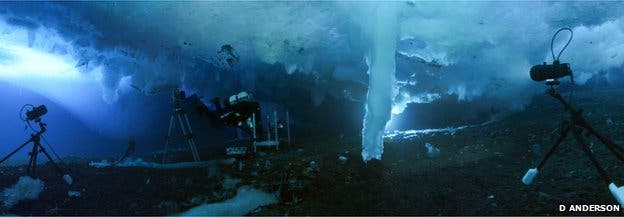
This incredible time-lapse footage was captured by a daring oceanographer for the BBC a while ago, showing for the very first time how a brinicle forms. It’s essentially a salt water icicle that gets bigger and bigger as it hits the sea floor, and when it does its icy touch puts life to a halt instantly, like the poor sea urchins and starfish.
Frozen sea water is more like a sponge than a big lump you’re used to seeing in your kitchen freezer. In the Antarctic, this is typically as low as -20 degrees Celsius so when it meets with warm water underneath it (-2 degrees Celsius tops), the extreme temperature differences expands the salt water into an icy sheath. Because this is dense and cold, the formation called a “brinicle” sinks in a descending plume. Brinicles grow both the Arctic and the Antarctic, and this particular one was shot by cameramen Hugh Miller and Doug Anderson for the BBC One series Frozen Planet.
Subscribe to our newsletter and receive our new book for FREE
Join 50,000+ subscribers vaccinated against pseudoscience
By subscribing you agree to our
Privacy Policy. Give it a try, you can unsubscribe anytime.
“When we were exploring around that island we came across an area where there had been three or four [brinicles] previously and there was one actually happening,” Mr Miller told BBC Nature.
“It was a bit of a race against time because no-one really knew how fast they formed,” said Mr Miller.
“The one we’d seen a week before was getting longer in front of our eyes… the whole thing only took five, six hours.”
“That particular patch was difficult to get to. It was a long way from the hole and it was quite narrow at times between the sea bed and the ice,” explained Mr Miller.
“I do remember it being a struggle… All the kit is very heavy because it has to sit on the sea bed and not move for long periods of time.”
Original Text (This is the original text for your reference.)
This incredible time-lapse footage was captured by a daring oceanographer for the BBC a while ago, showing for the very first time how a brinicle forms. It’s essentially a salt water icicle that gets bigger and bigger as it hits the sea floor, and when it does its icy touch puts life to a halt instantly, like the poor sea urchins and starfish.
Frozen sea water is more like a sponge than a big lump you’re used to seeing in your kitchen freezer. In the Antarctic, this is typically as low as -20 degrees Celsius so when it meets with warm water underneath it (-2 degrees Celsius tops), the extreme temperature differences expands the salt water into an icy sheath. Because this is dense and cold, the formation called a “brinicle” sinks in a descending plume. Brinicles grow both the Arctic and the Antarctic, and this particular one was shot by cameramen Hugh Miller and Doug Anderson for the BBC One series Frozen Planet.
Subscribe to our newsletter and receive our new book for FREE
Join 50,000+ subscribers vaccinated against pseudoscience
By subscribing you agree to our
Privacy Policy. Give it a try, you can unsubscribe anytime.
“When we were exploring around that island we came across an area where there had been three or four [brinicles] previously and there was one actually happening,” Mr Miller told BBC Nature.
“It was a bit of a race against time because no-one really knew how fast they formed,” said Mr Miller.
“The one we’d seen a week before was getting longer in front of our eyes… the whole thing only took five, six hours.”
“That particular patch was difficult to get to. It was a long way from the hole and it was quite narrow at times between the sea bed and the ice,” explained Mr Miller.
“I do remember it being a struggle… All the kit is very heavy because it has to sit on the sea bed and not move for long periods of time.”
Disclaimer: The translated content is provided by third-party translation service providers, and IKCEST shall not assume any responsibility for the accuracy and legality of the content.




 User Center
 My Training Class
 Feedback






 Report
 Share
Share





Comments
Something to say?
Log in or Sign up for free