Unearthed in southern China, this ancient fossil bears the most detailed and well preserved nervous system ever found. The preservation was so pristine that scientists were able to trace and count individual nerves, which help them describe an unique structure that is otherwise unknown in living organisms. Remarkably, the fossil is 520 million years old.
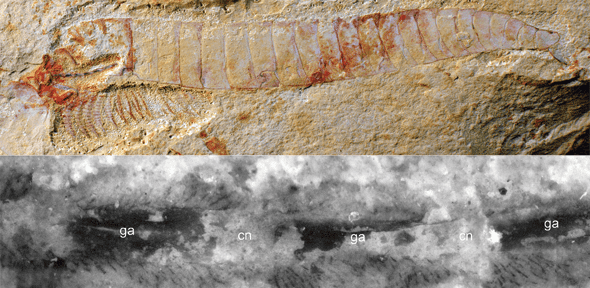
Complete specimen of Chengjiangocaris kunmingensis from the early Cambrian Xiaoshiba biota of South China. Bottom: Magnification of ventral nerve cord of Chengjiangocaris kunmingensis. Credit: Top: Jie Yang, Bottom: Yu Liu
Chengjiangocaris kunmingensis belongs to a group called fuxianhuiids, which are the forerunners of anthropods — a diverse modern group that includes insects, spiders and crustaceans. The crustacean-like C. kunmingensis sported a broad, almost heart-shaped head shield, and a long body with pairs of legs of varying sizes. It lived in a period called the Cambrian explosion — a brief evolutionary event during which most major animal phyla appeared. Before life exploded in the Cambrian 542 million years ago, Earth’s inhabitants were generally single-celled simple organisms. This was also a time of intense experimentation on nature’s part, and some of the weirdest creatures ever appeared during this time.
Generally, most fossils are bones or hard bodies and tissue is rarely found. Though rare, excavations sometimes reveal partially-fossilised nervous systems. Most such findings, however, are fossilized brains and even then scientists can only trace the profile with very limited information available about the nervous system’s structure.
Subscribe to our newsletter and receive our new book for FREE
Join 50,000+ subscribers vaccinated against pseudoscience
By subscribing you agree to our
Privacy Policy. Give it a try, you can unsubscribe anytime.
C. kunmingensis did not have a brain. Instead, the animal had a nerve cord (similar to a spinal chord in vertebrates) running throughout its body which consists of a chain-like series of interconnected masses of nervous tissue called ganglia. Each gaglia controlled a single pair of walking legs.
Using fluorescence microscopy, researchers at University of Cambridge found the gaglia were made of dozens of spindly fibres, each measuring about five thousandths of a millimetre in length. These became fossilized as carbon films.
The nervous system seems very similar to that of the priapulids (penis worms) and onychophorans (velvet worms), with regularly-spaced nerves coming out from the ventral nerve cord. The spindly fibres seem to have been lost independently in the tardigrades (water bears) and modern arthropods.
“This is a unique glimpse into what the ancestral nervous system looked like,” said study co-author Dr Javier Ortega-Hernández, of the University of Cambridge’s Department of Zoology. “It’s the most complete example of a central nervous system from the Cambrian period.”
“The more of these fossils we find, the more we will be able to understand how the nervous system – and how early animals – evolved,” said Ortega-Hernández.
Original Text (This is the original text for your reference.)
Unearthed in southern China, this ancient fossil bears the most detailed and well preserved nervous system ever found. The preservation was so pristine that scientists were able to trace and count individual nerves, which help them describe an unique structure that is otherwise unknown in living organisms. Remarkably, the fossil is 520 million years old.
Complete specimen of Chengjiangocaris kunmingensis from the early Cambrian Xiaoshiba biota of South China. Bottom: Magnification of ventral nerve cord of Chengjiangocaris kunmingensis. Credit: Top: Jie Yang, Bottom: Yu Liu
Chengjiangocaris kunmingensis belongs to a group called fuxianhuiids, which are the forerunners of anthropods — a diverse modern group that includes insects, spiders and crustaceans. The crustacean-like C. kunmingensis sported a broad, almost heart-shaped head shield, and a long body with pairs of legs of varying sizes. It lived in a period called the Cambrian explosion — a brief evolutionary event during which most major animal phyla appeared. Before life exploded in the Cambrian 542 million years ago, Earth’s inhabitants were generally single-celled simple organisms. This was also a time of intense experimentation on nature’s part, and some of the weirdest creatures ever appeared during this time.
Generally, most fossils are bones or hard bodies and tissue is rarely found. Though rare, excavations sometimes reveal partially-fossilised nervous systems. Most such findings, however, are fossilized brains and even then scientists can only trace the profile with very limited information available about the nervous system’s structure.
Subscribe to our newsletter and receive our new book for FREE
Join 50,000+ subscribers vaccinated against pseudoscience
By subscribing you agree to our
Privacy Policy. Give it a try, you can unsubscribe anytime.
C. kunmingensis did not have a brain. Instead, the animal had a nerve cord (similar to a spinal chord in vertebrates) running throughout its body which consists of a chain-like series of interconnected masses of nervous tissue called ganglia. Each gaglia controlled a single pair of walking legs.
Using fluorescence microscopy, researchers at University of Cambridge found the gaglia were made of dozens of spindly fibres, each measuring about five thousandths of a millimetre in length. These became fossilized as carbon films.
The nervous system seems very similar to that of the priapulids (penis worms) and onychophorans (velvet worms), with regularly-spaced nerves coming out from the ventral nerve cord. The spindly fibres seem to have been lost independently in the tardigrades (water bears) and modern arthropods.
“This is a unique glimpse into what the ancestral nervous system looked like,” said study co-author Dr Javier Ortega-Hernández, of the University of Cambridge’s Department of Zoology. “It’s the most complete example of a central nervous system from the Cambrian period.”
“The more of these fossils we find, the more we will be able to understand how the nervous system – and how early animals – evolved,” said Ortega-Hernández.
Disclaimer: The translated content is provided by third-party translation service providers, and IKCEST shall not assume any responsibility for the accuracy and legality of the content.




 User Center
 My Training Class
 Feedback






 Report
 Share
Share





Comments
Something to say?
Log in or Sign up for free