

Welcome to the IKCEST
New high-speed railway bridge advances connectivity in northwest China

A major bridge on the Yan'an-Yulin high-speed railway in northwest China's Shaanxi Province was successfully joined on November 1, marking a key milestone in the railway's construction.

The Qingjian River Bridge, technically challenging section of the railway, stretches 670.55 meters across the Qingjian River in Yan'an. Located in the rugged loess landscape of northern Shaanxi, the bridge presented considerable engineering challenges due to the area's complex geological conditions and the terrain along the river.
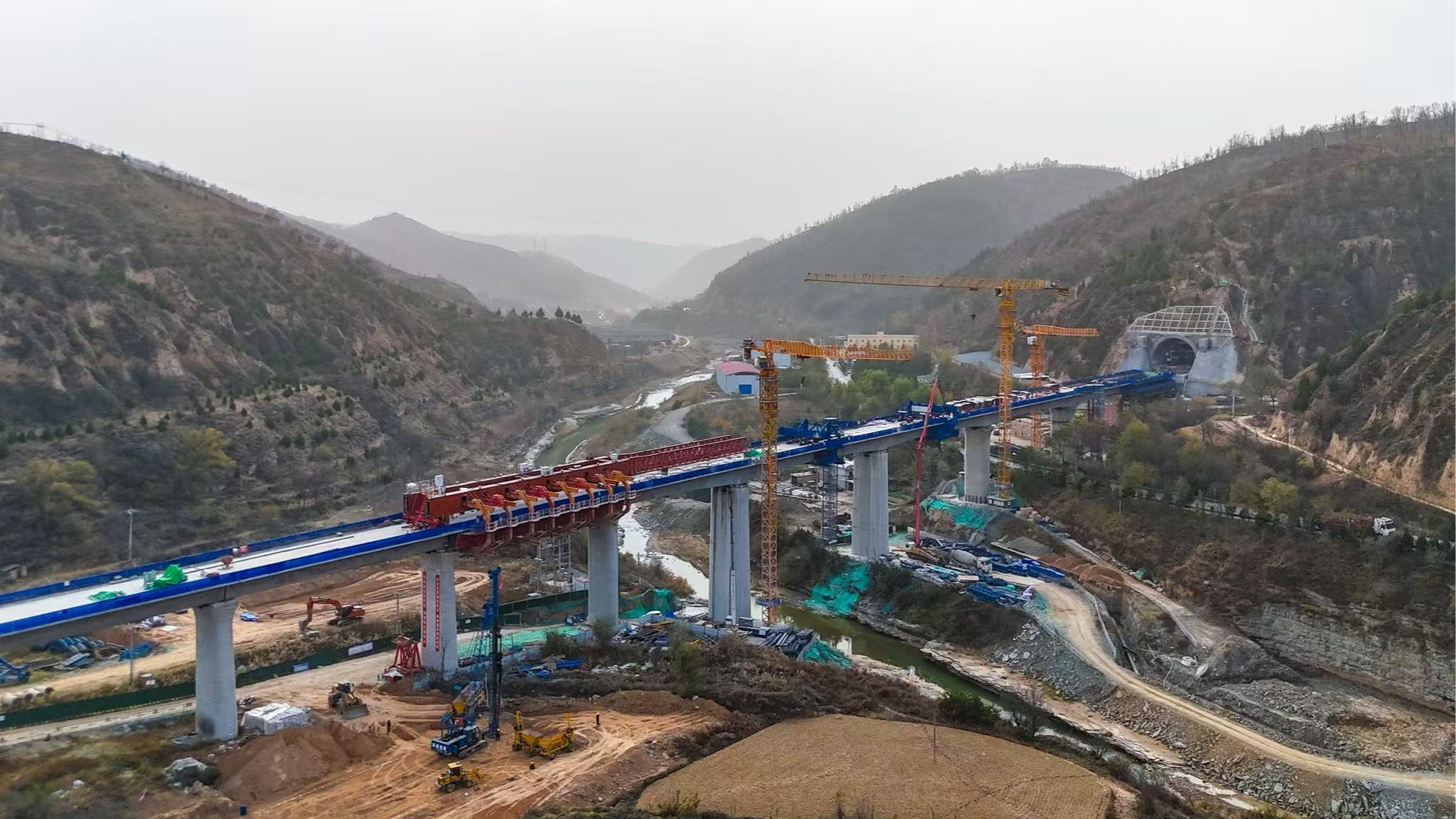
The Qingjian River Bridge of the Yan'an-Yulin high-speed railway in northwest China's Shaanxi Province was successfully joined, November 1, 2026. /CGTN

The Qingjian River Bridge of the Yan'an-Yulin high-speed railway in northwest China's Shaanxi Province was successfully joined, November 1, 2026. /CGTN

The bridge's main river-crossing and road-crossing sections feature continuous girders built using the balanced cantilever method. This technique involves casting concrete segments in place with movable formwork and requires precise construction coordination and stringent safety management.

"To address the challenges of bridge construction in loess terrain, we adopted a vertical excavation method supported by steel sheet piles for the bridge's pile-cap foundations. We also built the piers and abutments on slopes from the bottom up to effectively prevent and mitigate geological risks," said Zhang Li, chief engineer of the Qingjian River Bridge project. "These measures helped ensure the quality and timely completion of the construction work."

To ensure construction safety and quality, the project team has also introduced a range of digital monitoring systems, including real-time concrete quality monitoring at batching plants and remote video surveillance. These systems enable full-process traceability and real-time monitoring of key stages, from concrete production to continuous-girder construction.

The Yan'an-Yulin high-speed railway is a key section of the Baotou-Yinchuan-Haikou railway link, one of the major routes in China's high-speed rail network plan, which envisions "eight vertical lines running north-south and eight horizontal lines running east-west." The 238.7-kilometer line runs through northern Shaanxi and is designed for trains traveling at speeds of up to 350 kilometers per hour. It will provide a convenient passenger transport link between western Inner Mongolia and northern Shaanxi and the Central, Southwest and South Central regions of China. 

Once operational, the railway will significantly reduce travel times across the region. The journey between Yan'an and Yulin is expected to take around one hour, while travel between Xi'an and Yulin will be cut from approximately five hours to around two hours. The project is expected to improve regional connectivity, facilitate the movement of people and goods, and support high-quality economic and social development of northern Shaanxi.


Original Text (This is the original text for your reference.)

A major bridge on the Yan'an-Yulin high-speed railway in northwest China's Shaanxi Province was successfully joined on November 1, marking a key milestone in the railway's construction.

The Qingjian River Bridge, technically challenging section of the railway, stretches 670.55 meters across the Qingjian River in Yan'an. Located in the rugged loess landscape of northern Shaanxi, the bridge presented considerable engineering challenges due to the area's complex geological conditions and the terrain along the river.

The Qingjian River Bridge of the Yan'an-Yulin high-speed railway in northwest China's Shaanxi Province was successfully joined, November 1, 2026. /CGTN

The Qingjian River Bridge of the Yan'an-Yulin high-speed railway in northwest China's Shaanxi Province was successfully joined, November 1, 2026. /CGTN

The bridge's main river-crossing and road-crossing sections feature continuous girders built using the balanced cantilever method. This technique involves casting concrete segments in place with movable formwork and requires precise construction coordination and stringent safety management.

"To address the challenges of bridge construction in loess terrain, we adopted a vertical excavation method supported by steel sheet piles for the bridge's pile-cap foundations. We also built the piers and abutments on slopes from the bottom up to effectively prevent and mitigate geological risks," said Zhang Li, chief engineer of the Qingjian River Bridge project. "These measures helped ensure the quality and timely completion of the construction work."

To ensure construction safety and quality, the project team has also introduced a range of digital monitoring systems, including real-time concrete quality monitoring at batching plants and remote video surveillance. These systems enable full-process traceability and real-time monitoring of key stages, from concrete production to continuous-girder construction.

The Yan'an-Yulin high-speed railway is a key section of the Baotou-Yinchuan-Haikou railway link, one of the major routes in China's high-speed rail network plan, which envisions "eight vertical lines running north-south and eight horizontal lines running east-west." The 238.7-kilometer line runs through northern Shaanxi and is designed for trains traveling at speeds of up to 350 kilometers per hour. It will provide a convenient passenger transport link between western Inner Mongolia and northern Shaanxi and the Central, Southwest and South Central regions of China. 

Once operational, the railway will significantly reduce travel times across the region. The journey between Yan'an and Yulin is expected to take around one hour, while travel between Xi'an and Yulin will be cut from approximately five hours to around two hours. The project is expected to improve regional connectivity, facilitate the movement of people and goods, and support high-quality economic and social development of northern Shaanxi.

Comments

    Something to say?

    Login or Sign up for free

    Disclaimer: The translated content is provided by third-party translation service providers, and IKCEST shall not assume any responsibility for the accuracy and legality of the content.
    Translate engine
    Article's language
    English
    中文
    Pусск
    Français
    Español
    العربية
    Português
    Kikongo
    Dutch
    kiswahili
    هَوُسَ
    IsiZulu
    Action
    Related

    Report

    Select your report category *


    Reason *


    By pressing send, your feedback will be used to improve IKCEST. Your privacy will be protected.

    Submit
    Cancel