

Welcome to the IKCEST
China steps up green transition, strengthens climate action
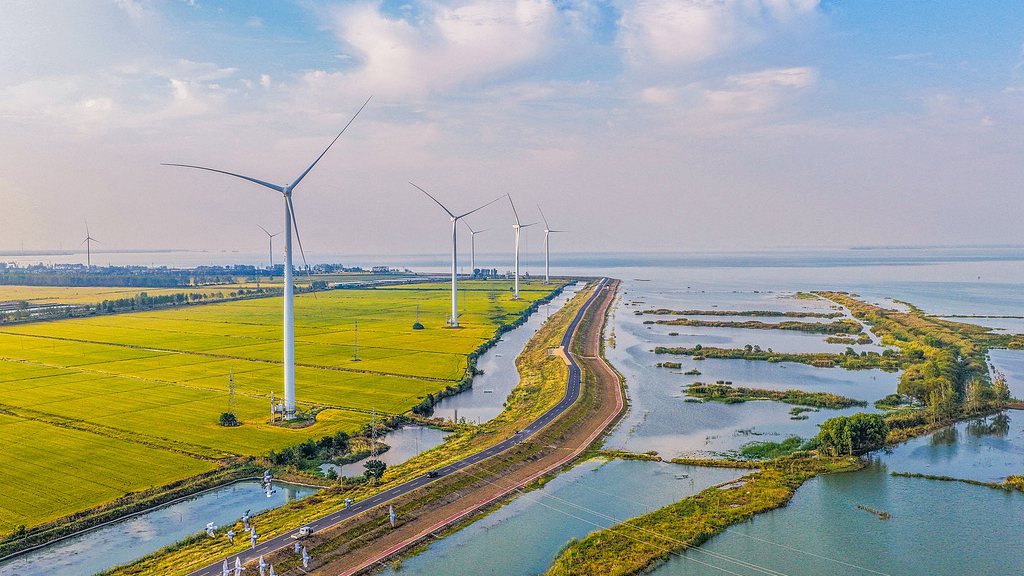
Wind turbines stand tall along the shore of Hongze Lake, east China's Jiangsu Province, October 8, 2026. /VCG

Wind turbines stand tall along the shore of Hongze Lake, east China's Jiangsu Province, October 8, 2026. /VCG

China will accelerate its green and low-carbon transition, promote the peaking of coal and oil consumption, and work to fulfill its 2030 Nationally Determined Contributions (NDCs) during the 15th Five-Year Plan period (2026-2030), an environmental official said at a press conference on Wednesday, underscoring the country's continued efforts to address climate change.

China has made significant progress in its green and low-carbon transition. In the first half of this year, the country's installed renewable energy capacity reached 2.455 billion kilowatts, accounting for 60.7% of its total installed power generation capacity. By the end of July, installed solar power capacity had surpassed coal-fired power capacity for the first time, making it China's largest power source, said Li Gao, vice minister of ecology and environment, highlighting the country's strong momentum in green development.

Li added that China ranked first in the world in the combined installed capacity of nuclear power units in operation and those approved and under construction. The country has also ranked first globally in new energy vehicle production and sales for 11 consecutive years. It has built the world's largest and most comprehensive clean energy industrial chain, with green and low-carbon industries becoming an important driver of economic growth.

China has also strengthened its institutional system for addressing climate change, Li said.

The Ecological Environment Code, which came into force in August, includes a dedicated chapter on climate change, marking the first time China's legislation has made specific provisions on the issue.

Efforts to achieve China's "dual carbon" goals – reaching carbon peaking before 2030 and achieving carbon neutrality by 2060 – have been incorporated into central environmental protection inspections, while the green and low-carbon transformation of development approaches has been included in assessments of building a Beautiful China.

So far, China has issued 113 national standards for carbon emissions management, with more than 50 additional standards expected this year, covering areas including carbon accounting, carbon trading and carbon footprints, Li said.

Carbon market enters a new phase of growth
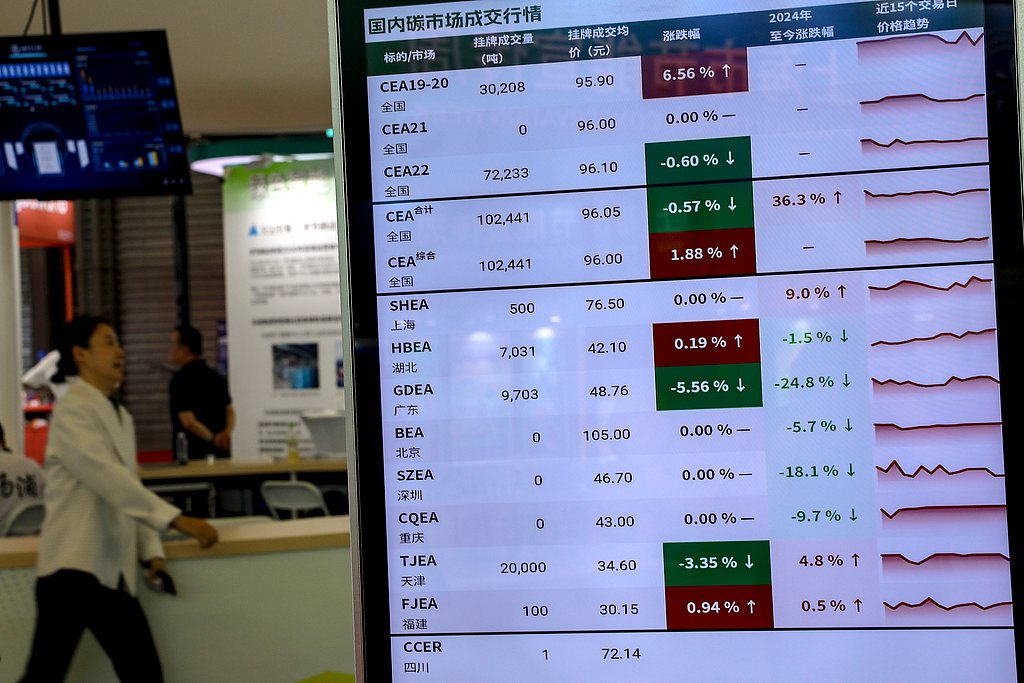
A digital screen showing trading activity in China's domestic carbon market in 2024. /VCG

A digital screen showing trading activity in China's domestic carbon market in 2024. /VCG

China has established the world's largest national carbon emissions trading market, while its voluntary greenhouse gas emissions reduction trading market continues to expand, Li noted.

The cumulative trading volume in the national carbon market recently surpassed 1 billion tonnes. The market also covered about 8.3 billion tonnes of carbon dioxide emissions, accounting for over 65% of the country's total.

During the 14th Five-Year Plan period (2021-2025), China's carbon market helped reduce carbon dioxide emissions in the thermal power sector by about 530 million tonnes. It also generated around 36 billion yuan (about $5.4 billion) in emission-reduction benefits for more than 1,100 key emitting entities, and lowered the country's cumulative emission-reduction costs by 56.8 billion yuan (about $8.5 billion).

Meanwhile, China has been improving its carbon emissions statistics and accounting systems, with progress achieved in establishing the product carbon footprint management framework. The database of national greenhouse gas emission factor has been launched, while carbon management capabilities among industries and enterprises continue to improve.


Original Text (This is the original text for your reference.)

Wind turbines stand tall along the shore of Hongze Lake, east China's Jiangsu Province, October 8, 2026. /VCG

Wind turbines stand tall along the shore of Hongze Lake, east China's Jiangsu Province, October 8, 2026. /VCG

China will accelerate its green and low-carbon transition, promote the peaking of coal and oil consumption, and work to fulfill its 2030 Nationally Determined Contributions (NDCs) during the 15th Five-Year Plan period (2026-2030), an environmental official said at a press conference on Wednesday, underscoring the country's continued efforts to address climate change.

China has made significant progress in its green and low-carbon transition. In the first half of this year, the country's installed renewable energy capacity reached 2.455 billion kilowatts, accounting for 60.7% of its total installed power generation capacity. By the end of July, installed solar power capacity had surpassed coal-fired power capacity for the first time, making it China's largest power source, said Li Gao, vice minister of ecology and environment, highlighting the country's strong momentum in green development.

Li added that China ranked first in the world in the combined installed capacity of nuclear power units in operation and those approved and under construction. The country has also ranked first globally in new energy vehicle production and sales for 11 consecutive years. It has built the world's largest and most comprehensive clean energy industrial chain, with green and low-carbon industries becoming an important driver of economic growth.

China has also strengthened its institutional system for addressing climate change, Li said.

The Ecological Environment Code, which came into force in August, includes a dedicated chapter on climate change, marking the first time China's legislation has made specific provisions on the issue.

Efforts to achieve China's "dual carbon" goals – reaching carbon peaking before 2030 and achieving carbon neutrality by 2060 – have been incorporated into central environmental protection inspections, while the green and low-carbon transformation of development approaches has been included in assessments of building a Beautiful China.

So far, China has issued 113 national standards for carbon emissions management, with more than 50 additional standards expected this year, covering areas including carbon accounting, carbon trading and carbon footprints, Li said.

Carbon market enters a new phase of growth

A digital screen showing trading activity in China's domestic carbon market in 2024. /VCG

A digital screen showing trading activity in China's domestic carbon market in 2024. /VCG

China has established the world's largest national carbon emissions trading market, while its voluntary greenhouse gas emissions reduction trading market continues to expand, Li noted.

The cumulative trading volume in the national carbon market recently surpassed 1 billion tonnes. The market also covered about 8.3 billion tonnes of carbon dioxide emissions, accounting for over 65% of the country's total.

During the 14th Five-Year Plan period (2021-2025), China's carbon market helped reduce carbon dioxide emissions in the thermal power sector by about 530 million tonnes. It also generated around 36 billion yuan (about $5.4 billion) in emission-reduction benefits for more than 1,100 key emitting entities, and lowered the country's cumulative emission-reduction costs by 56.8 billion yuan (about $8.5 billion).

Meanwhile, China has been improving its carbon emissions statistics and accounting systems, with progress achieved in establishing the product carbon footprint management framework. The database of national greenhouse gas emission factor has been launched, while carbon management capabilities among industries and enterprises continue to improve.

Comments

    Something to say?

    Login or Sign up for free

    Disclaimer: The translated content is provided by third-party translation service providers, and IKCEST shall not assume any responsibility for the accuracy and legality of the content.
    Translate engine
    Article's language
    English
    中文
    Pусск
    Français
    Español
    العربية
    Português
    Kikongo
    Dutch
    kiswahili
    هَوُسَ
    IsiZulu
    Action
    Related

    Report

    Select your report category *


    Reason *


    By pressing send, your feedback will be used to improve IKCEST. Your privacy will be protected.

    Submit
    Cancel