

Welcome to the IKCEST
What the world can learn from China's 'whole-system' approach

Editor's note: As land degradation, desertification and drought continue to threaten food and water security, livelihoods and climate resilience worldwide, the conclusion of the UNCCD COP17 has renewed attention to how global commitments can be translated into concrete action. CGTN invites Zhang Shouhong, dean of the School of Soil and Water Conservation under Beijing Forestry University and deputy director of the China-Mongolia Cooperative Center for Combating Desertification, and Gao Guanglei, deputy dean of the school and deputy director of the General Office of the center, to examine the technological, governance and financial challenges facing global land restoration. They also explain how China's whole-system approach to combating desertification, along with its cooperation with Mongolia, could offer practical experience and institutional know-how for global ecological governance. The article reflects the authors' opinions, and not necessarily those of CGTN.

Shanshan County on the edge of the Kumtag Desert, northwest China's Xinjiang Uygur Autonomous Region. /VCG

Shanshan County on the edge of the Kumtag Desert, northwest China's Xinjiang Uygur Autonomous Region. /VCG

More than 3 billion people – two out of every five on Earth – are already feeling the sting of degraded land. Desertification and drought are no longer fringe environmental issues; they are silent drivers of hunger, water scarcity, climate chaos and mass displacement. But with 40% of our planet's land in decline, good intentions are not enough. What we urgently need are sharper technologies, smarter governance and bigger financial commitments – because when the earth turns to dust, so do our futures.

The triple bottleneck: Technology, governance and finance

At COP17, the question was no longer "should we do something?" but who pays, who acts and who makes sure it actually happens.

Technology comes first – but it cannot be a one‑size‑fits‑all solution. Land degradation takes many forms: salinization, erosion, desertification, biodiversity loss. Each demands a tailored response. What we need is a simple, practical cycle in every at‑risk region: diagnose the soil, restore it adaptively and keep monitoring it over time.

But tech alone is useless without the right institutions. Too often, restoration projects are siloed – cut off from agriculture, water management, finance, or planning ministries. That has to change. Every country should embed land degradation neutrality targets into their Nationally Determined Contributions and National Adaptation Plans, and set up cross‑ministerial coordination mechanisms.

And neither can move forward without money – which brings us to the biggest bottleneck of all. The UNCCD has played a vital role in promoting international cooperation, but implementation has consistently stumbled on one hard truth: funding is far too scarce and far too fragmented. What is now needed is a clear, innovative financing roadmap. More critically, we need to unlock global carbon markets and the Green Climate Fund, so that restored land can generate measurable, tradeable economic returns – turning restoration from a cost into an investment.
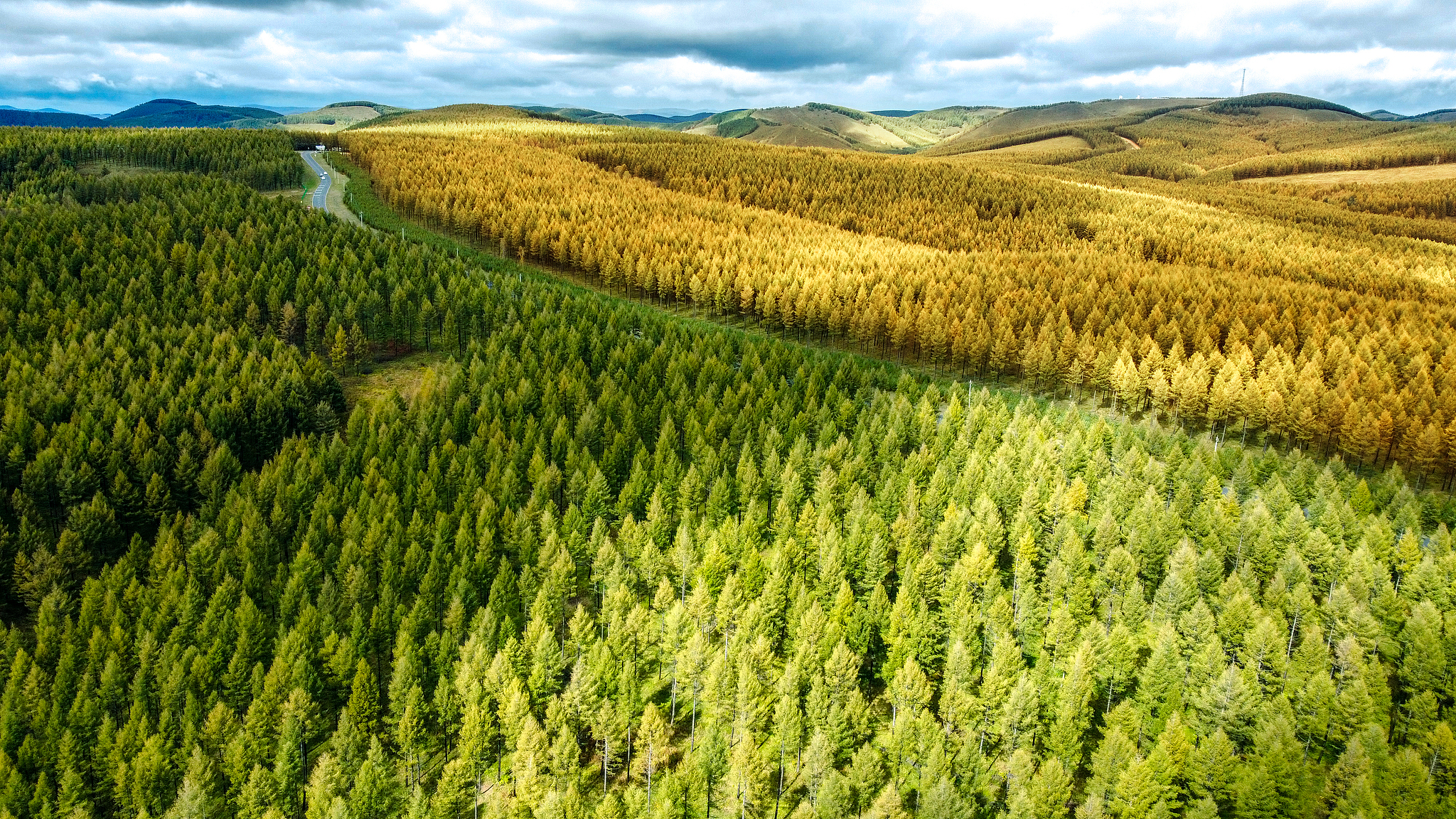
Saihanba Mechanized Forest Farm in Hebei Province, part of China's Three-North Shelterbelt Program. /VCG

Saihanba Mechanized Forest Farm in Hebei Province, part of China's Three-North Shelterbelt Program. /VCG

China's experience: A six-in-one system

The success of China's desertification control is not attributable to any single key factor, but rather results from the synergistic effect of a six-in-one system comprising "government leadership, public participation, project-driven approaches, industry-driven mechanisms, legal safeguards and scientific and technological support."

It starts at the top. China has elevated sand prevention and control to a long‑term national strategy – from the launch of the Three‑North Shelterbelt Program in 1978 to today's comprehensive ecological restoration projects.

But top‑down planning alone would have fallen flat without grassroots energy. Think of the Babusha "six old men" in northwest China's Gansu Province, who contracted to control sand across three generations of their family.

Guided by major national projects. The Three‑North Shelterbelt Program, Grain‑for‑Green program, and the Beijing‑Tianjin Sand Source Control Project – efforts have been concentrated on large‑scale restoration in key regions.

One of the smartest moves has been linking ecology with economy. The "photovoltaic + sand control" model, which has gained wide popularity in recent years, is a prime example. This industry‑driven approach solves the age‑old dilemma of "investment without returns," giving local communities a lasting stake in keeping the land healthy.

Law and regulation provide the backbone. China enacted and enforced the world's first Law on Prevention and Control of Desertification, supplemented by regulations on closed protection zones and institutional plans for restoration.

Finally, technology acts as the engine that powers every other piece of the system. At Beijing Forestry University, for example, we have developed theories and technologies for shelterbelt system construction and mobile sand dune management.

But these tools are not isolated – they are deeply integrated into strategic planning, legal supervision, project implementation and industrial development, jointly forming what we call a replicable and scalable "China solution."

A view of Mesquite Flat Sand Dunes as the temperature shows 46 degrees Celsius in Death Valley National Park of California, the United States, July 17, 2025. /VCG

A view of Mesquite Flat Sand Dunes as the temperature shows 46 degrees Celsius in Death Valley National Park of California, the United States, July 17, 2025. /VCG

What we must do now: Share technology, unlock funding

No single country can win this fight alone.

On technology transfer, we must establish a cross‑border system that truly works. Existing technologies urgently need to be shared and scaled through the UNCCD platform. That means building a complete chain that covers needs assessment, regional matching, joint piloting, personnel training, joint standard‑setting, financing arrangements and performance monitoring. Only then can we turn regional experiences into international public goods.

On financing, we need more targeted policies that address the chronic mismatch between supply and demand. In policy design, we must pragmatically build incentive mechanisms that make land restoration projects genuinely attractive to investors – and we must promote the harmonious development of sand control and poverty alleviation, so that ecological protection and livelihood improvement go hand in hand.

A desert landscape in Mongolia. /VCG

A desert landscape in Mongolia. /VCG

Shared solutions, shared future: Cross‑border cooperation in action

The China‑Mongolia Cooperative Center for Combating Desertification is a tangible outcome of diplomatic interactions between the heads of state of the two countries. Beijing Forestry University has been entrusted with actively, efficiently and steadily implementing the relevant work on the ground.

So far, site selection for two demonstration bases and ecological observation stations – one in Ulaanbaatar and one in Zamyn‑Uud – has been completed, and their functional layouts have been preliminarily defined.

The Ulaanbaatar site focuses more on urban‑periphery ecological restoration: seedling cultivation, green space development, windbreak and sand fixation, and public education.

The Zamyn‑Uud site, in contrast, sits in a vital transport corridor in southern Mongolia and an area highly sensitive to wind and sand activity. Here, the emphasis is on cross‑border sand and dust monitoring, low‑water‑consumption vegetation restoration, and long‑term ecological observation.

Through them, we hope to apply China's proven experience in water‑efficient afforestation, mixed arbor‑shrub‑grass configurations, seedling cultivation, remote‑sensing monitoring and long‑term management – so that Mongolia can observe, learn from and replicate these models. And in doing so, we aim to contribute not just to Mongolia, but to global ecological governance more broadly.
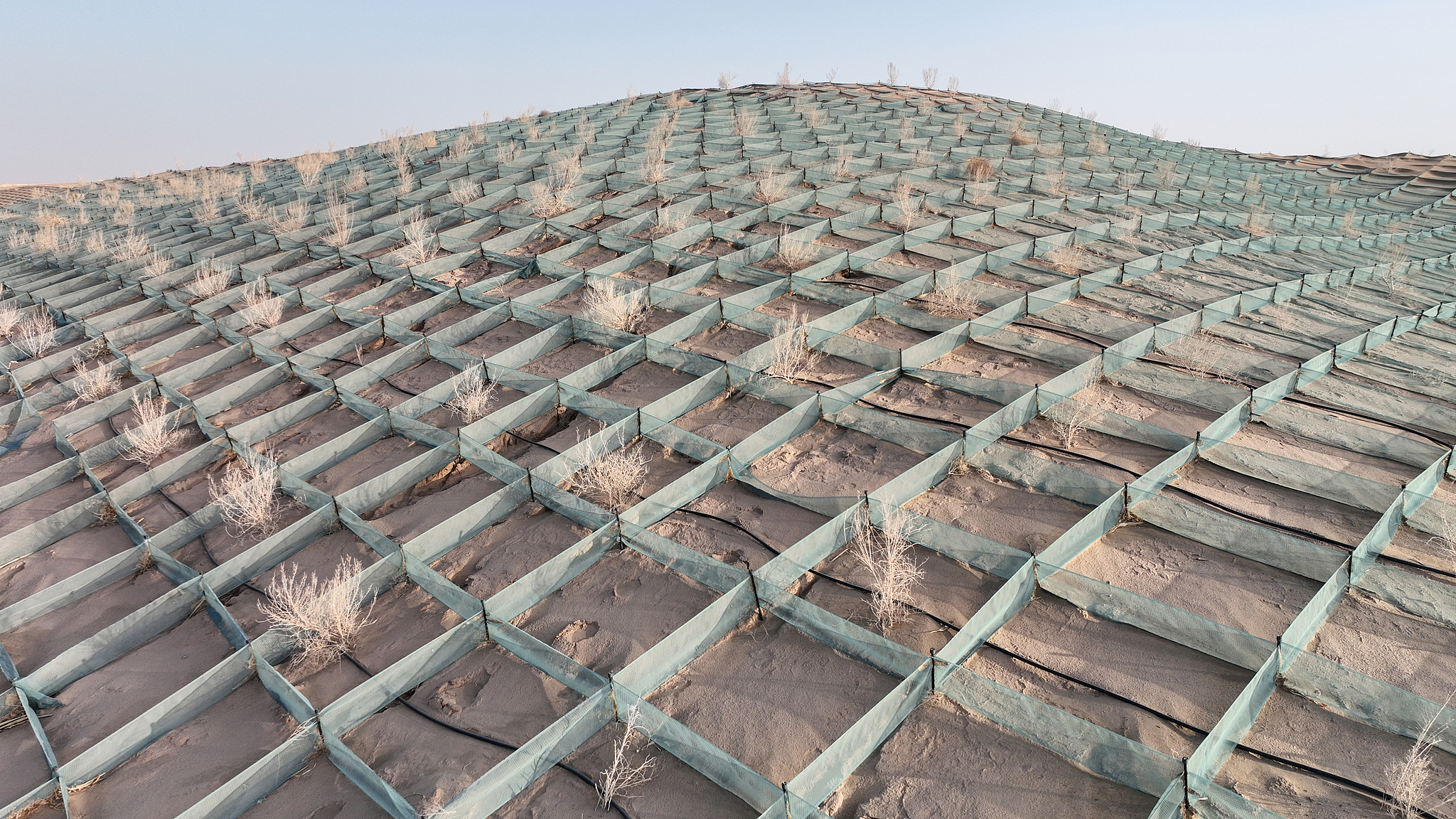
Sand-control nets and straw checkerboards on dunes in Jiuquan, Gansu Province, northwest China, January 22, 2026. /VCG

Sand-control nets and straw checkerboards on dunes in Jiuquan, Gansu Province, northwest China, January 22, 2026. /VCG

China's contributions: Institutional know‑how for the world

From the perspective of global governance, the core value of China's experience no longer lies in individual technologies or project scales. It lies in a systematic governance model characterized by: long‑term planning as the overarching guide, ecological zoning as the foundation, multi‑scale coordination as the organizational approach, combined measures as the implementation means, and continuous monitoring as the feedback mechanism.

It is the institutional public goods we can offer: long‑term planning methodologies, ecological zoning approaches, multi‑scale governance mechanisms, integrated technology systems and monitoring‑and‑evaluation standards that can be adapted and adopted by other countries facing similar challenges.

We are ready to join hands with international and domestic partners to combat land desertification, land degradation and drought for "restoring land, restoring hope."


Original Text (This is the original text for your reference.)

Editor's note: As land degradation, desertification and drought continue to threaten food and water security, livelihoods and climate resilience worldwide, the conclusion of the UNCCD COP17 has renewed attention to how global commitments can be translated into concrete action. CGTN invites Zhang Shouhong, dean of the School of Soil and Water Conservation under Beijing Forestry University and deputy director of the China-Mongolia Cooperative Center for Combating Desertification, and Gao Guanglei, deputy dean of the school and deputy director of the General Office of the center, to examine the technological, governance and financial challenges facing global land restoration. They also explain how China's whole-system approach to combating desertification, along with its cooperation with Mongolia, could offer practical experience and institutional know-how for global ecological governance. The article reflects the authors' opinions, and not necessarily those of CGTN.

Shanshan County on the edge of the Kumtag Desert, northwest China's Xinjiang Uygur Autonomous Region. /VCG

Shanshan County on the edge of the Kumtag Desert, northwest China's Xinjiang Uygur Autonomous Region. /VCG

More than 3 billion people – two out of every five on Earth – are already feeling the sting of degraded land. Desertification and drought are no longer fringe environmental issues; they are silent drivers of hunger, water scarcity, climate chaos and mass displacement. But with 40% of our planet's land in decline, good intentions are not enough. What we urgently need are sharper technologies, smarter governance and bigger financial commitments – because when the earth turns to dust, so do our futures.

The triple bottleneck: Technology, governance and finance

At COP17, the question was no longer "should we do something?" but who pays, who acts and who makes sure it actually happens.

Technology comes first – but it cannot be a one‑size‑fits‑all solution. Land degradation takes many forms: salinization, erosion, desertification, biodiversity loss. Each demands a tailored response. What we need is a simple, practical cycle in every at‑risk region: diagnose the soil, restore it adaptively and keep monitoring it over time.

But tech alone is useless without the right institutions. Too often, restoration projects are siloed – cut off from agriculture, water management, finance, or planning ministries. That has to change. Every country should embed land degradation neutrality targets into their Nationally Determined Contributions and National Adaptation Plans, and set up cross‑ministerial coordination mechanisms.

And neither can move forward without money – which brings us to the biggest bottleneck of all. The UNCCD has played a vital role in promoting international cooperation, but implementation has consistently stumbled on one hard truth: funding is far too scarce and far too fragmented. What is now needed is a clear, innovative financing roadmap. More critically, we need to unlock global carbon markets and the Green Climate Fund, so that restored land can generate measurable, tradeable economic returns – turning restoration from a cost into an investment.

Saihanba Mechanized Forest Farm in Hebei Province, part of China's Three-North Shelterbelt Program. /VCG

Saihanba Mechanized Forest Farm in Hebei Province, part of China's Three-North Shelterbelt Program. /VCG

China's experience: A six-in-one system

The success of China's desertification control is not attributable to any single key factor, but rather results from the synergistic effect of a six-in-one system comprising "government leadership, public participation, project-driven approaches, industry-driven mechanisms, legal safeguards and scientific and technological support."

It starts at the top. China has elevated sand prevention and control to a long‑term national strategy – from the launch of the Three‑North Shelterbelt Program in 1978 to today's comprehensive ecological restoration projects.

But top‑down planning alone would have fallen flat without grassroots energy. Think of the Babusha "six old men" in northwest China's Gansu Province, who contracted to control sand across three generations of their family.

Guided by major national projects. The Three‑North Shelterbelt Program, Grain‑for‑Green program, and the Beijing‑Tianjin Sand Source Control Project – efforts have been concentrated on large‑scale restoration in key regions.

One of the smartest moves has been linking ecology with economy. The "photovoltaic + sand control" model, which has gained wide popularity in recent years, is a prime example. This industry‑driven approach solves the age‑old dilemma of "investment without returns," giving local communities a lasting stake in keeping the land healthy.

Law and regulation provide the backbone. China enacted and enforced the world's first Law on Prevention and Control of Desertification, supplemented by regulations on closed protection zones and institutional plans for restoration.

Finally, technology acts as the engine that powers every other piece of the system. At Beijing Forestry University, for example, we have developed theories and technologies for shelterbelt system construction and mobile sand dune management.

But these tools are not isolated – they are deeply integrated into strategic planning, legal supervision, project implementation and industrial development, jointly forming what we call a replicable and scalable "China solution."

A view of Mesquite Flat Sand Dunes as the temperature shows 46 degrees Celsius in Death Valley National Park of California, the United States, July 17, 2025. /VCG

A view of Mesquite Flat Sand Dunes as the temperature shows 46 degrees Celsius in Death Valley National Park of California, the United States, July 17, 2025. /VCG

What we must do now: Share technology, unlock funding

No single country can win this fight alone.

On technology transfer, we must establish a cross‑border system that truly works. Existing technologies urgently need to be shared and scaled through the UNCCD platform. That means building a complete chain that covers needs assessment, regional matching, joint piloting, personnel training, joint standard‑setting, financing arrangements and performance monitoring. Only then can we turn regional experiences into international public goods.

On financing, we need more targeted policies that address the chronic mismatch between supply and demand. In policy design, we must pragmatically build incentive mechanisms that make land restoration projects genuinely attractive to investors – and we must promote the harmonious development of sand control and poverty alleviation, so that ecological protection and livelihood improvement go hand in hand.

A desert landscape in Mongolia. /VCG

A desert landscape in Mongolia. /VCG

Shared solutions, shared future: Cross‑border cooperation in action

The China‑Mongolia Cooperative Center for Combating Desertification is a tangible outcome of diplomatic interactions between the heads of state of the two countries. Beijing Forestry University has been entrusted with actively, efficiently and steadily implementing the relevant work on the ground.

So far, site selection for two demonstration bases and ecological observation stations – one in Ulaanbaatar and one in Zamyn‑Uud – has been completed, and their functional layouts have been preliminarily defined.

The Ulaanbaatar site focuses more on urban‑periphery ecological restoration: seedling cultivation, green space development, windbreak and sand fixation, and public education.

The Zamyn‑Uud site, in contrast, sits in a vital transport corridor in southern Mongolia and an area highly sensitive to wind and sand activity. Here, the emphasis is on cross‑border sand and dust monitoring, low‑water‑consumption vegetation restoration, and long‑term ecological observation.

Through them, we hope to apply China's proven experience in water‑efficient afforestation, mixed arbor‑shrub‑grass configurations, seedling cultivation, remote‑sensing monitoring and long‑term management – so that Mongolia can observe, learn from and replicate these models. And in doing so, we aim to contribute not just to Mongolia, but to global ecological governance more broadly.

Sand-control nets and straw checkerboards on dunes in Jiuquan, Gansu Province, northwest China, January 22, 2026. /VCG

Sand-control nets and straw checkerboards on dunes in Jiuquan, Gansu Province, northwest China, January 22, 2026. /VCG

China's contributions: Institutional know‑how for the world

From the perspective of global governance, the core value of China's experience no longer lies in individual technologies or project scales. It lies in a systematic governance model characterized by: long‑term planning as the overarching guide, ecological zoning as the foundation, multi‑scale coordination as the organizational approach, combined measures as the implementation means, and continuous monitoring as the feedback mechanism.

It is the institutional public goods we can offer: long‑term planning methodologies, ecological zoning approaches, multi‑scale governance mechanisms, integrated technology systems and monitoring‑and‑evaluation standards that can be adapted and adopted by other countries facing similar challenges.

We are ready to join hands with international and domestic partners to combat land desertification, land degradation and drought for "restoring land, restoring hope."

Comments

    Something to say?

    Login or Sign up for free

    Disclaimer: The translated content is provided by third-party translation service providers, and IKCEST shall not assume any responsibility for the accuracy and legality of the content.
    Translate engine
    Article's language
    English
    中文
    Pусск
    Français
    Español
    العربية
    Português
    Kikongo
    Dutch
    kiswahili
    هَوُسَ
    IsiZulu
    Action
    Related

    Report

    Select your report category *


    Reason *


    By pressing send, your feedback will be used to improve IKCEST. Your privacy will be protected.

    Submit
    Cancel