


Welcome to the IKCEST
China's desert-control expertise helps tackle global desertification

As desertification threatens ecosystems and livelihoods across many parts of the world, China's experience in combating advancing sands is offering new insights to countries seeking to restore degraded land.

Surrounded by deserts on three sides, Ningxia Hui Autonomous Region in northwest China has spent decades battling desertification. Decades of desert-control efforts have transformed the once sand-threatened region into a model of ecological restoration.
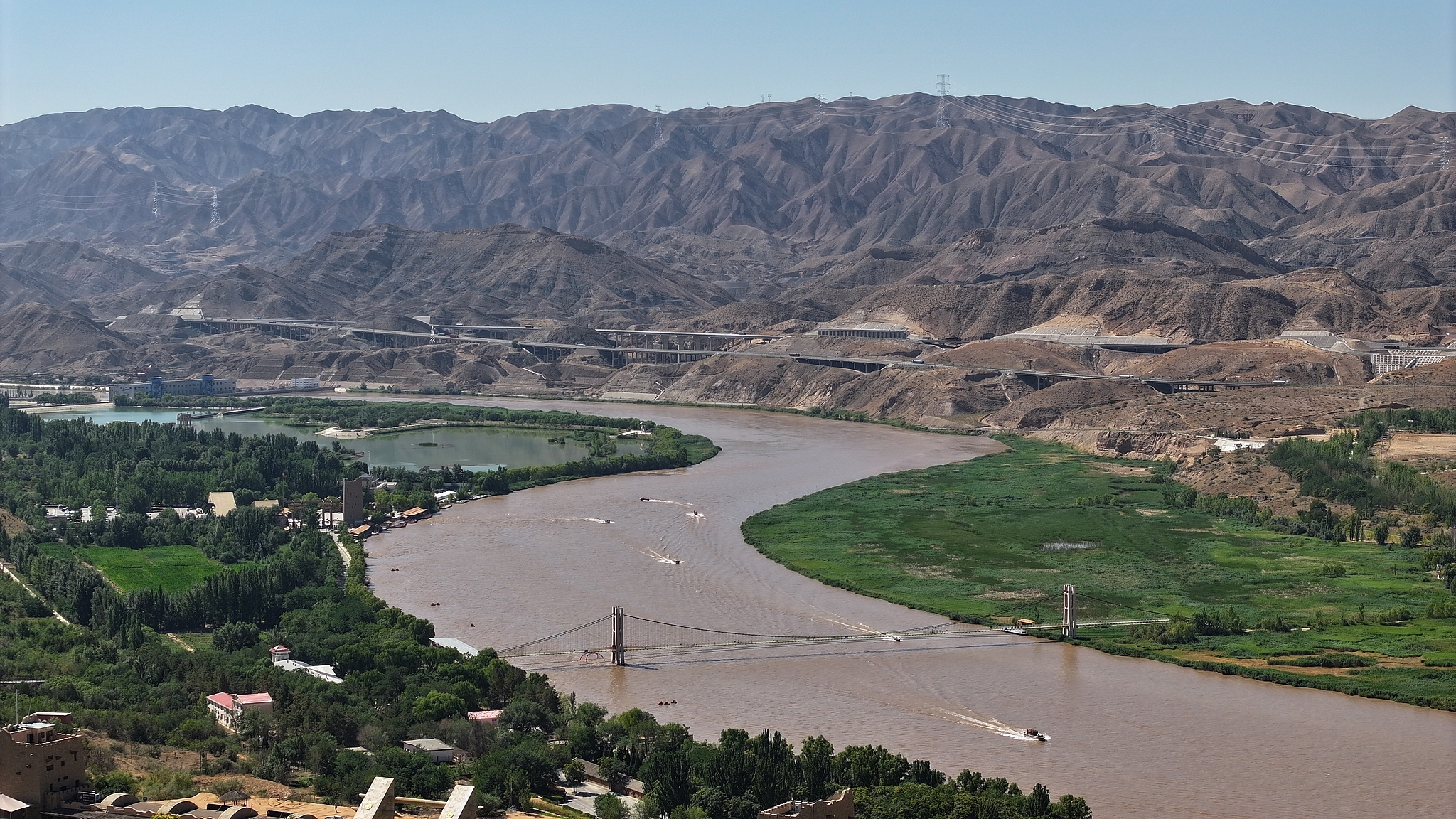
Zhongwei City at the southeast edge of the Tengger Desert, Ningxia Hui Autonomous Region, northwest China, July 7, 2026. /VCG

Zhongwei City at the southeast edge of the Tengger Desert, Ningxia Hui Autonomous Region, northwest China, July 7, 2026. /VCG

Established in 2025, the China-Central Asia desertification prevention and control cooperation center, based in Ningxia, serves as a platform for technical exchanges, joint research and pilot projects, helping connect China's experience with the ecological conditions and development needs of partner nations.

Among the techniques attracting international attention is the straw checkerboard, a method developed and widely applied in China in which straw is arranged in a grid pattern and partially buried in shifting sand to stabilize dunes and create conditions for vegetation growth.

Yet Chinese experts emphasize that there is no one-size-fits-all approach to desertification control. "Whether an approach works depends on local conditions," said Huang Wei, deputy director of the cooperation center and a senior engineer.

During an anti-desertification workshop held last month in Dushanbe, Tajikistan, Huang tailored the curriculum to address the country's mountainous terrain and severe soil erosion, adding sessions on mountain afforestation, soil conservation, forest pest management and wildfire prevention.

The same demand-driven approach underpins the center's pilot projects now under development, including an urban green-space demonstration zone in Uzbekistan, a seedling propagation base in Kyrgyzstan, and a program involving smart greenhouses in Kazakhstan.

Gulom Bekmirzaev, a professor at Uzbekistan's Green University specializing in desertification control and desert economy studies, has attended several training programs in China. He hopes to organize similar programs in Uzbekistan so that more people can benefit from shared experience.

The latest example came in late July, when a three-week training program opened in Yinchuan, the regional capital, bringing together 34 ecological experts and officials from Iraq, Jordan, Tunisia and three other Arab countries.

"We are here to explore how China's experience can be adapted to our own conditions," said Saifeddine Eturki, a researcher at Tunisia's Arid Regions Institute.

China's desert-control experience has also provided insights that benefit ecological restoration efforts in other parts of the world. In Saudi Arabia, China's integration of photovoltaic development with desert restoration has offered new ideas for balancing renewable energy development and land rehabilitation. Lessons from China's Three-North Shelterbelt Forest Program have also been shared to support the Great Green Wall Initiative on the African continent.

"Sandstorms know no borders," said Feng Zhanwen, director of the cooperation center. "Sharing experience and solutions is essential as countries work together to address this common challenge."


Source(s): Xinhua News Agency

Original Text (This is the original text for your reference.)

As desertification threatens ecosystems and livelihoods across many parts of the world, China's experience in combating advancing sands is offering new insights to countries seeking to restore degraded land.

Surrounded by deserts on three sides, Ningxia Hui Autonomous Region in northwest China has spent decades battling desertification. Decades of desert-control efforts have transformed the once sand-threatened region into a model of ecological restoration.

Zhongwei City at the southeast edge of the Tengger Desert, Ningxia Hui Autonomous Region, northwest China, July 7, 2026. /VCG

Zhongwei City at the southeast edge of the Tengger Desert, Ningxia Hui Autonomous Region, northwest China, July 7, 2026. /VCG

Established in 2025, the China-Central Asia desertification prevention and control cooperation center, based in Ningxia, serves as a platform for technical exchanges, joint research and pilot projects, helping connect China's experience with the ecological conditions and development needs of partner nations.

Among the techniques attracting international attention is the straw checkerboard, a method developed and widely applied in China in which straw is arranged in a grid pattern and partially buried in shifting sand to stabilize dunes and create conditions for vegetation growth.

Yet Chinese experts emphasize that there is no one-size-fits-all approach to desertification control. "Whether an approach works depends on local conditions," said Huang Wei, deputy director of the cooperation center and a senior engineer.

During an anti-desertification workshop held last month in Dushanbe, Tajikistan, Huang tailored the curriculum to address the country's mountainous terrain and severe soil erosion, adding sessions on mountain afforestation, soil conservation, forest pest management and wildfire prevention.

The same demand-driven approach underpins the center's pilot projects now under development, including an urban green-space demonstration zone in Uzbekistan, a seedling propagation base in Kyrgyzstan, and a program involving smart greenhouses in Kazakhstan.

Gulom Bekmirzaev, a professor at Uzbekistan's Green University specializing in desertification control and desert economy studies, has attended several training programs in China. He hopes to organize similar programs in Uzbekistan so that more people can benefit from shared experience.

The latest example came in late July, when a three-week training program opened in Yinchuan, the regional capital, bringing together 34 ecological experts and officials from Iraq, Jordan, Tunisia and three other Arab countries.

"We are here to explore how China's experience can be adapted to our own conditions," said Saifeddine Eturki, a researcher at Tunisia's Arid Regions Institute.

China's desert-control experience has also provided insights that benefit ecological restoration efforts in other parts of the world. In Saudi Arabia, China's integration of photovoltaic development with desert restoration has offered new ideas for balancing renewable energy development and land rehabilitation. Lessons from China's Three-North Shelterbelt Forest Program have also been shared to support the Great Green Wall Initiative on the African continent.

"Sandstorms know no borders," said Feng Zhanwen, director of the cooperation center. "Sharing experience and solutions is essential as countries work together to address this common challenge."

Source(s): Xinhua News Agency
Comments

    Something to say?

    Login or Sign up for free

    Disclaimer: The translated content is provided by third-party translation service providers, and IKCEST shall not assume any responsibility for the accuracy and legality of the content.
    Translate engine
    Article's language
    English
    中文
    Pусск
    Français
    Español
    العربية
    Português
    Kikongo
    Dutch
    kiswahili
    هَوُسَ
    IsiZulu
    Action
    Related

    Report

    Select your report category *


    Reason *


    By pressing send, your feedback will be used to improve IKCEST. Your privacy will be protected.

    Submit
    Cancel