


Welcome to the IKCEST
China uses drone swarm for first full observation of Typhoon Noul

China has completed its first full-process observation of a typhoon using a swarm of meteorological drones, marking the country's first use of drone swarm technology to monitor a typhoon throughout its entire passage, according to the China Meteorological Administration (CMA).
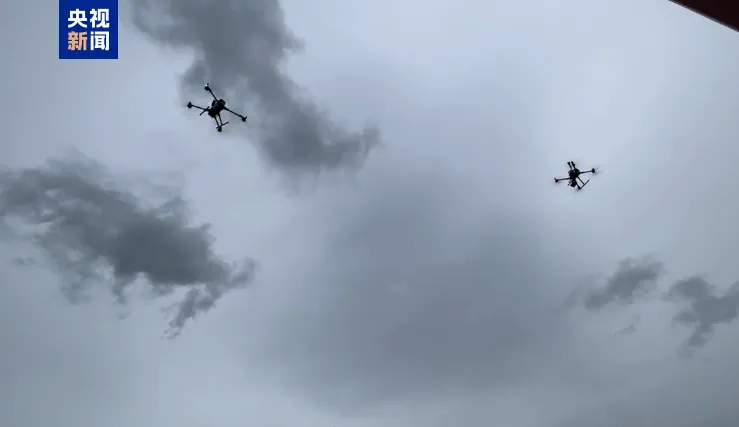
Drone swarm is deployed for observation of Typhoon Noul in Shenzhen, Guangdong Province, south China, July 26, 2026. /China Media Group

Drone swarm is deployed for observation of Typhoon Noul in Shenzhen, Guangdong Province, south China, July 26, 2026. /China Media Group

The field experiment was conducted at a CMA research base for meteorological support of low-altitude uncrewed aviation on Shenzhen's Dapeng Peninsula during the passage of Typhoon Noul.

Unlike conventional operations involving a single drone, the system deploys multiple drones equipped with meteorological sensors to carry out coordinated observations simultaneously at different locations and altitudes. The drone swarm enables high-density, three-dimensional sampling of the lower atmosphere, overcoming the limitations of single-point observations and improving data collection over coastal waters and other areas where low-altitude observations have traditionally been limited.

Throughout the experiment, researchers continuously collected vertical profiles of key atmospheric variables, including temperature, humidity, wind fields and turbulence, before, during and after the typhoon's passage. The drones also recorded operational data such as flight attitude, trajectory deviation and battery power consumption, providing valuable data for defining the meteorological limits of safe drone operations under extreme weather conditions.

The observations are expected to provide critical observational data for improving typhoon monitoring and forecasting, while also contributing to research on the operational limits of safe drone flights in extreme weather.


Original Text (This is the original text for your reference.)

China has completed its first full-process observation of a typhoon using a swarm of meteorological drones, marking the country's first use of drone swarm technology to monitor a typhoon throughout its entire passage, according to the China Meteorological Administration (CMA).

Drone swarm is deployed for observation of Typhoon Noul in Shenzhen, Guangdong Province, south China, July 26, 2026. /China Media Group

Drone swarm is deployed for observation of Typhoon Noul in Shenzhen, Guangdong Province, south China, July 26, 2026. /China Media Group

The field experiment was conducted at a CMA research base for meteorological support of low-altitude uncrewed aviation on Shenzhen's Dapeng Peninsula during the passage of Typhoon Noul.

Unlike conventional operations involving a single drone, the system deploys multiple drones equipped with meteorological sensors to carry out coordinated observations simultaneously at different locations and altitudes. The drone swarm enables high-density, three-dimensional sampling of the lower atmosphere, overcoming the limitations of single-point observations and improving data collection over coastal waters and other areas where low-altitude observations have traditionally been limited.

Throughout the experiment, researchers continuously collected vertical profiles of key atmospheric variables, including temperature, humidity, wind fields and turbulence, before, during and after the typhoon's passage. The drones also recorded operational data such as flight attitude, trajectory deviation and battery power consumption, providing valuable data for defining the meteorological limits of safe drone operations under extreme weather conditions.

The observations are expected to provide critical observational data for improving typhoon monitoring and forecasting, while also contributing to research on the operational limits of safe drone flights in extreme weather.

Comments

    Something to say?

    Login or Sign up for free

    Disclaimer: The translated content is provided by third-party translation service providers, and IKCEST shall not assume any responsibility for the accuracy and legality of the content.
    Translate engine
    Article's language
    English
    中文
    Pусск
    Français
    Español
    العربية
    Português
    Kikongo
    Dutch
    kiswahili
    هَوُسَ
    IsiZulu
    Action
    Related

    Report

    Select your report category *


    Reason *


    By pressing send, your feedback will be used to improve IKCEST. Your privacy will be protected.

    Submit
    Cancel