

Welcome to the IKCEST
Chinese researchers set world record for tandem solar cell efficiency
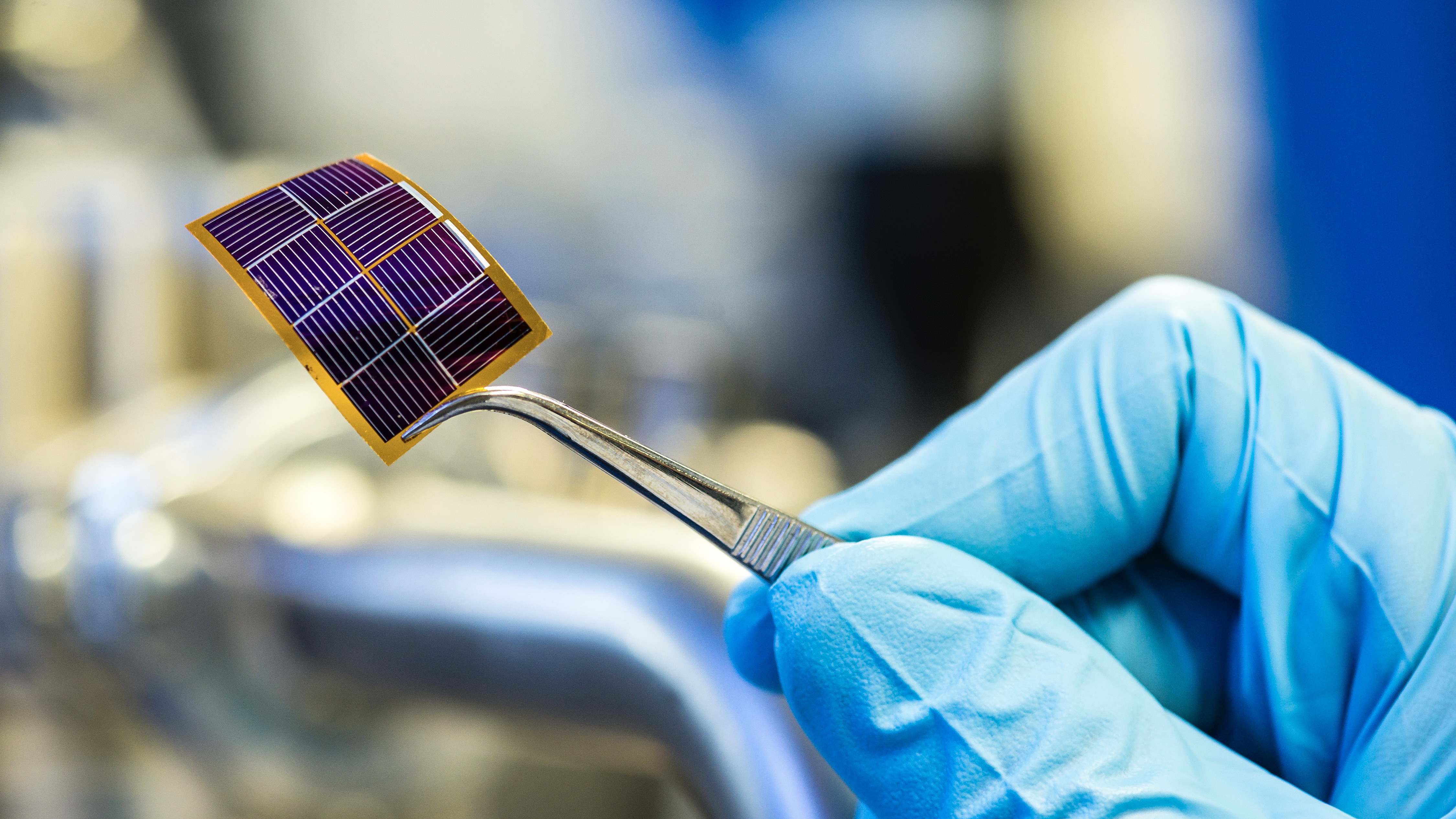
Illustration shows thin-film solar cells. /VCG

Illustration shows thin-film solar cells. /VCG

A team of Chinese researchers has achieved a certified power conversion efficiency of 28.04% for a perovskite-organic tandem solar cell, setting a world record for the technology and bringing it a step closer to practical applications, according to a study published in Nature on Sunday.

The research was led by Academician Li Yongfang and researcher Meng Lei from the Institute of Chemistry under the Chinese Academy of Sciences.

Unlike conventional single-junction solar cells, such as the silicon photovoltaic panels widely used on rooftops and in solar farms, tandem solar cells stack two light-absorbing materials on top of each other. Each layer captures a different part of the solar spectrum, allowing the cells to convert sunlight into electricity more efficiently while remaining thin, lightweight and flexible.

The technology is considered promising for applications where lightweight power sources are needed, including building-integrated photovoltaics, portable energy systems, wearable electronics, drones and spacecraft.

To address long-standing challenges involving performance degradation and limited stability, the researchers introduced a new additive molecule known as TDB. The molecule regulates the material throughout both the fabrication process and operation under illumination, offering a potential solution to one of the technology's key bottlenecks.

Third-party certification showed the solar cell achieved a steady-state power conversion efficiency of 28.04%, setting a new world record for perovskite-organic tandem solar cells. It also demonstrated strong operational stability, retaining 90% of its initial efficiency after 625 hours of continuous illumination.

According to the researchers, the technology could eventually be adapted for a range of applications, including buildings, transportation, wearable electronics, and satellites, where lightweight, flexible solar cells could offer advantages over conventional photovoltaic panels.


Original Text (This is the original text for your reference.)

Illustration shows thin-film solar cells. /VCG

Illustration shows thin-film solar cells. /VCG

A team of Chinese researchers has achieved a certified power conversion efficiency of 28.04% for a perovskite-organic tandem solar cell, setting a world record for the technology and bringing it a step closer to practical applications, according to a study published in Nature on Sunday.

The research was led by Academician Li Yongfang and researcher Meng Lei from the Institute of Chemistry under the Chinese Academy of Sciences.

Unlike conventional single-junction solar cells, such as the silicon photovoltaic panels widely used on rooftops and in solar farms, tandem solar cells stack two light-absorbing materials on top of each other. Each layer captures a different part of the solar spectrum, allowing the cells to convert sunlight into electricity more efficiently while remaining thin, lightweight and flexible.

The technology is considered promising for applications where lightweight power sources are needed, including building-integrated photovoltaics, portable energy systems, wearable electronics, drones and spacecraft.

To address long-standing challenges involving performance degradation and limited stability, the researchers introduced a new additive molecule known as TDB. The molecule regulates the material throughout both the fabrication process and operation under illumination, offering a potential solution to one of the technology's key bottlenecks.

Third-party certification showed the solar cell achieved a steady-state power conversion efficiency of 28.04%, setting a new world record for perovskite-organic tandem solar cells. It also demonstrated strong operational stability, retaining 90% of its initial efficiency after 625 hours of continuous illumination.

According to the researchers, the technology could eventually be adapted for a range of applications, including buildings, transportation, wearable electronics, and satellites, where lightweight, flexible solar cells could offer advantages over conventional photovoltaic panels.

Comments

    Something to say?

    Login or Sign up for free

    Disclaimer: The translated content is provided by third-party translation service providers, and IKCEST shall not assume any responsibility for the accuracy and legality of the content.
    Translate engine
    Article's language
    English
    中文
    Pусск
    Français
    Español
    العربية
    Português
    Kikongo
    Dutch
    kiswahili
    هَوُسَ
    IsiZulu
    Action
    Related

    Report

    Select your report category *


    Reason *


    By pressing send, your feedback will be used to improve IKCEST. Your privacy will be protected.

    Submit
    Cancel