

Welcome to the IKCEST
Typhoon Bavi: Eastern China braces for imminent landfall
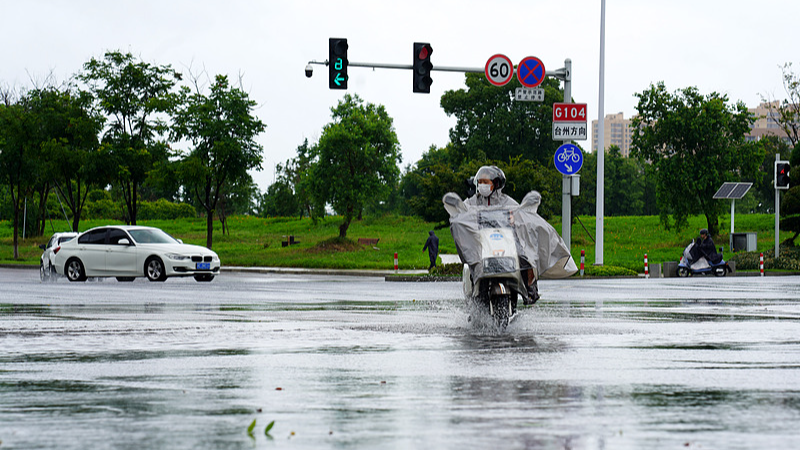
Vehicles drive on a city road in Yueqing, Wenzhou, east China's Zhejiang Province, July 11, 2026. /VCG

Vehicles drive on a city road in Yueqing, Wenzhou, east China's Zhejiang Province, July 11, 2026. /VCG

Eastern China is bracing for impact as Typhoon Bavi, the ninth storm of the season, is forecast to make landfall earlier than expected on Saturday night or early Sunday along the coast from Wenling to Rui'an in Zhejiang Province.

Revised track and intensity

The National Meteorological Center kept its orange typhoon warning in place at 6 p.m. on Saturday. Bavi weakened from a severe typhoon to a typhoon at noon, with maximum sustained winds of 40 m/s (Force 13) near its center at 5 p.m., according to the center. 

The system was located about 165 kilometers southeast of Wenling in the East China Sea, with a minimum central pressure of 950 hPa.

Moving northwest at roughly 30 km/h, the storm is expected to weaken gradually after landfall before turning northward.

Zhejiang mobilizes full-scale response

Zhejiang Province raised its emergency response to Level I – the highest in China's four-tier system – at 11 a.m. on Saturday as Bavi approached. 

The province has fully activated its emergency command system, with 46,000 flood control personnel on duty and 308,000 local community workers deployed.

As of 8 a.m., Zhejiang had evacuated nearly 1.72 million residents. All 12,154 primary and secondary schools and kindergartens have suspended classes, 830 construction sites have halted work, and 163 passenger ferry routes are suspended. 

A total of 38 trains and 461 flights have been canceled, and 444 A-level tourist attractions have been temporarily closed.

In Wenzhou, authorities have stockpiled over 600 inflatable rescue boats, more than 12,000 satellite phones and generators, and over 150,000 pieces of emergency equipment.

Vulnerable groups prioritized

Local authorities in Ningbo, Wenzhou, Jinhua, and Lishui have urged residents to stay indoors unless absolutely necessary, and advised them to secure windows and balconies, stock up on water and food, and avoid flooded areas.

Elderly residents in high-risk areas are being given priority. In Wenling's Gehai Village – a small island where 95 percent of the 172 permanent residents are elderly – officials made sure vulnerable residents were relocated to shelters, with medical personnel on hand.

Multi-agency coordination

China's State Flood Control and Drought Relief Headquarters raised its emergency response for Zhejiang and Fujian to Level II on Friday and dispatched working groups to assist. 

The Ministry of Water Resources elevated its flood prevention response in the two provinces to Level III on Saturday.

Separately, the ministry activated a Level IV emergency response in Beijing, Tianjin, and Hebei, as moisture from Bavi's outer bands combined with cold air is expected to bring heavy to torrential rainfall to northern and northeastern regions in the coming days.

Sustained response

"Typhoon Bavi is expected to make landfall directly in Zhejiang, bringing strong winds and heavy rainfall along its path," said Hu Yaowen, chief engineer of the Zhejiang Provincial Department of Emergency Management. "Some areas in the Wenzhou-Taizhou-Lishui region may experience extremely heavy downpours, potentially triggering secondary disasters."

(Cover via VCG)

Original Text (This is the original text for your reference.)

Vehicles drive on a city road in Yueqing, Wenzhou, east China's Zhejiang Province, July 11, 2026. /VCG

Vehicles drive on a city road in Yueqing, Wenzhou, east China's Zhejiang Province, July 11, 2026. /VCG

Eastern China is bracing for impact as Typhoon Bavi, the ninth storm of the season, is forecast to make landfall earlier than expected on Saturday night or early Sunday along the coast from Wenling to Rui'an in Zhejiang Province.

Revised track and intensity

The National Meteorological Center kept its orange typhoon warning in place at 6 p.m. on Saturday. Bavi weakened from a severe typhoon to a typhoon at noon, with maximum sustained winds of 40 m/s (Force 13) near its center at 5 p.m., according to the center. 

The system was located about 165 kilometers southeast of Wenling in the East China Sea, with a minimum central pressure of 950 hPa.

Moving northwest at roughly 30 km/h, the storm is expected to weaken gradually after landfall before turning northward.

Zhejiang mobilizes full-scale response

Zhejiang Province raised its emergency response to Level I – the highest in China's four-tier system – at 11 a.m. on Saturday as Bavi approached. 

The province has fully activated its emergency command system, with 46,000 flood control personnel on duty and 308,000 local community workers deployed.

As of 8 a.m., Zhejiang had evacuated nearly 1.72 million residents. All 12,154 primary and secondary schools and kindergartens have suspended classes, 830 construction sites have halted work, and 163 passenger ferry routes are suspended. 

A total of 38 trains and 461 flights have been canceled, and 444 A-level tourist attractions have been temporarily closed.

In Wenzhou, authorities have stockpiled over 600 inflatable rescue boats, more than 12,000 satellite phones and generators, and over 150,000 pieces of emergency equipment.

Vulnerable groups prioritized

Local authorities in Ningbo, Wenzhou, Jinhua, and Lishui have urged residents to stay indoors unless absolutely necessary, and advised them to secure windows and balconies, stock up on water and food, and avoid flooded areas.

Elderly residents in high-risk areas are being given priority. In Wenling's Gehai Village – a small island where 95 percent of the 172 permanent residents are elderly – officials made sure vulnerable residents were relocated to shelters, with medical personnel on hand.

Multi-agency coordination

China's State Flood Control and Drought Relief Headquarters raised its emergency response for Zhejiang and Fujian to Level II on Friday and dispatched working groups to assist. 

The Ministry of Water Resources elevated its flood prevention response in the two provinces to Level III on Saturday.

Separately, the ministry activated a Level IV emergency response in Beijing, Tianjin, and Hebei, as moisture from Bavi's outer bands combined with cold air is expected to bring heavy to torrential rainfall to northern and northeastern regions in the coming days.

Sustained response

"Typhoon Bavi is expected to make landfall directly in Zhejiang, bringing strong winds and heavy rainfall along its path," said Hu Yaowen, chief engineer of the Zhejiang Provincial Department of Emergency Management. "Some areas in the Wenzhou-Taizhou-Lishui region may experience extremely heavy downpours, potentially triggering secondary disasters."

(Cover via VCG)

Comments

    Something to say?

    Login or Sign up for free

    Disclaimer: The translated content is provided by third-party translation service providers, and IKCEST shall not assume any responsibility for the accuracy and legality of the content.
    Translate engine
    Article's language
    English
    中文
    Pусск
    Français
    Español
    العربية
    Português
    Kikongo
    Dutch
    kiswahili
    هَوُسَ
    IsiZulu
    Action
    Related

    Report

    Select your report category *


    Reason *


    By pressing send, your feedback will be used to improve IKCEST. Your privacy will be protected.

    Submit
    Cancel