

Welcome to the IKCEST
Shenzhou-23 crew installs spaceborne greenhouse gas detector
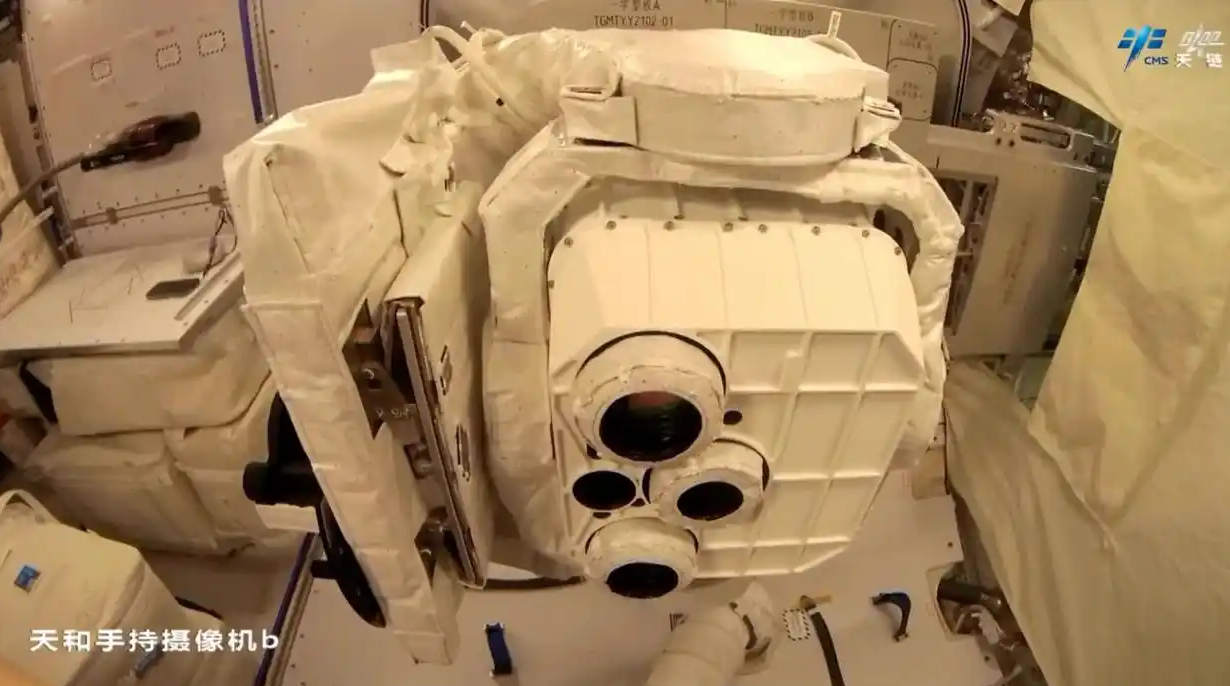
The Multi-Spectral Imaging Carbon Observatory aboard China's space station. /CMSA

The Multi-Spectral Imaging Carbon Observatory aboard China's space station. /CMSA

The Shenzhou-23 crew aboard China's space station completed the assembly, testing and extravehicular installation of the Multi-Spectral Imaging Carbon Observatory (MUSICO), the first spaceborne greenhouse gas detector of the space station, in the past week.

This compact, high-resolution and high-precision detector can monitor concentrations of carbon dioxide and methane in key regions across the mid-and-low latitude regions on the Earth.

It is expected to provide data for tracking global greenhouse gas emissions and for conducting ecological environment research.

In addition to equipment installation, The three astronauts, Zhu Yangzhu, Zhang Zhiyuan and Lai Ka-ying, carried out experiments on microgravity physics, and explored how the light environment affects human psychological perception and work efficiency in the space environment.

They also performed maintenance work for the space station and used equipment to measure their noise exposure.

To monitor their physiological changes in the microgravity environment, the astronauts collected, centrifuged and stored blood samples, underwent cardiovascular function tests, intraocular pressure and fundus examinations, as well as ultrasound scans of multiple body parts, completed bone density measurements, and used a special weighing scale to measure their body mass in orbit.


Original Text (This is the original text for your reference.)

The Multi-Spectral Imaging Carbon Observatory aboard China's space station. /CMSA

The Multi-Spectral Imaging Carbon Observatory aboard China's space station. /CMSA

The Shenzhou-23 crew aboard China's space station completed the assembly, testing and extravehicular installation of the Multi-Spectral Imaging Carbon Observatory (MUSICO), the first spaceborne greenhouse gas detector of the space station, in the past week.

This compact, high-resolution and high-precision detector can monitor concentrations of carbon dioxide and methane in key regions across the mid-and-low latitude regions on the Earth.

It is expected to provide data for tracking global greenhouse gas emissions and for conducting ecological environment research.

In addition to equipment installation, The three astronauts, Zhu Yangzhu, Zhang Zhiyuan and Lai Ka-ying, carried out experiments on microgravity physics, and explored how the light environment affects human psychological perception and work efficiency in the space environment.

They also performed maintenance work for the space station and used equipment to measure their noise exposure.

To monitor their physiological changes in the microgravity environment, the astronauts collected, centrifuged and stored blood samples, underwent cardiovascular function tests, intraocular pressure and fundus examinations, as well as ultrasound scans of multiple body parts, completed bone density measurements, and used a special weighing scale to measure their body mass in orbit.

Comments

    Something to say?

    Login or Sign up for free

    Disclaimer: The translated content is provided by third-party translation service providers, and IKCEST shall not assume any responsibility for the accuracy and legality of the content.
    Translate engine
    Article's language
    English
    中文
    Pусск
    Français
    Español
    العربية
    Português
    Kikongo
    Dutch
    kiswahili
    هَوُسَ
    IsiZulu
    Action
    Related

    Report

    Select your report category *


    Reason *


    By pressing send, your feedback will be used to improve IKCEST. Your privacy will be protected.

    Submit
    Cancel