


Welcome to the IKCEST
China, Central Asia to launch disaster-monitoring satellite network
Overseas buyers visit the TBEA booth during the 9th China-Eurasia Expo in Urumqi, northwest China's Xinjiang Uygur Autonomous Region, June 26, 2026. /VCG

Overseas buyers visit the TBEA booth during the 9th China-Eurasia Expo in Urumqi, northwest China's Xinjiang Uygur Autonomous Region, June 26, 2026. /VCG

China and several Central Asian countries are planning to develop a satellite constellation to share remote-sensing data and tackle common threats, such as earthquakes, agricultural pests, and glacial floods.

The tech cooperation agreement was signed on Thursday at the ongoing 9th China-Eurasia Expo held in Urumqi, capital of northwest China's Xinjiang Uygur Autonomous Region. Called the "Tianwu Constellation," the space-based monitoring network will comprise an initial system of five satellites, according to scientists involved in the project.

Tong Qingxi, a remote-sensing specialist with the Chinese Academy of Sciences, said that China's Xinjiang, bordering several Central Asian countries, has similar geographic conditions and common geological threats to its neighbors, such as earthquakes, landslides, and floods caused by glacial melt. The joint constellation is designed to address shared disaster-prevention needs.

"It is a practical application of the Belt and Road cooperation and a shared effort to build a community with a shared future for humanity," Tong said.

The project is more than a satellite deployment; it is an air-space-ground integrated system that operates through intelligent coordination. Scientists said satellite data collected over the region will be processed by a computing center in Xinjiang, where artificial intelligence (AI) models will be developed for geological disaster prediction, agricultural pest detection, and glacial melt monitoring.
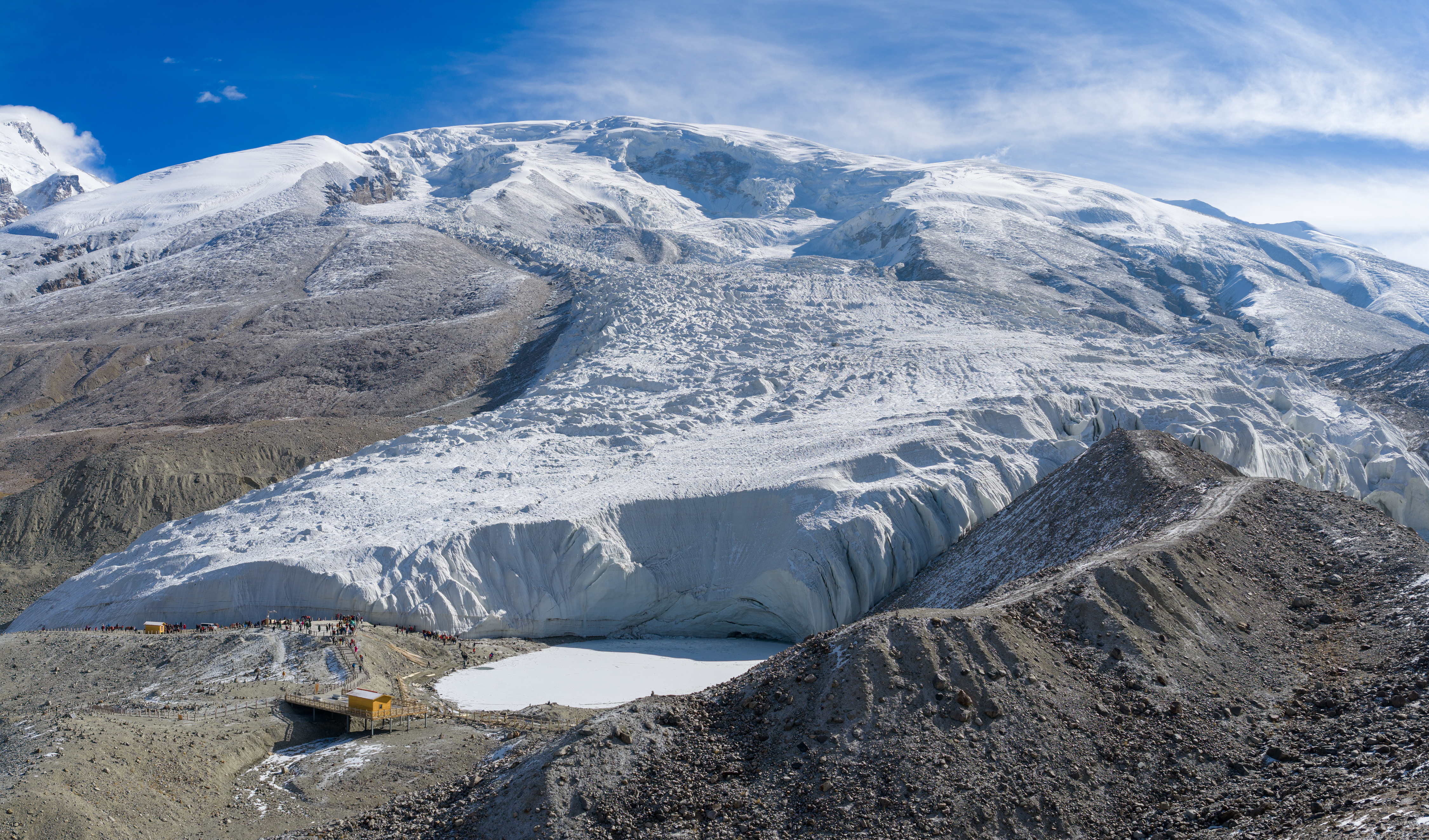
The Muztag Glacier stretches across the slopes of Muztag Ata on the Pamir Plateau in Kashi, northwest China's Xinjiang Uygur Autonomous Region, October 22, 2025. /VCG

The Muztag Glacier stretches across the slopes of Muztag Ata on the Pamir Plateau in Kashi, northwest China's Xinjiang Uygur Autonomous Region, October 22, 2025. /VCG

Chen Xi, an academic at the International Eurasian Academy of Sciences who has long studied glacial geology, noted that Xinjiang and neighboring Central Asian countries are linked by the same mountain ranges, and glaciers there have melted by 20 to 40 percent in recent years.

Regular and precise satellite monitoring of glacier changes will support water resource allocation and water supply security for the region, Chen said.

Scientists from Kazakhstan, Uzbekistan, and Tajikistan attended the signing ceremony. They expressed confidence that the joint project would bring mutual benefits.

Akobir Mirzorakhimzoda, vice president of the National Academy of Sciences of Tajikistan, said that mastering advanced technologies, such as satellite networking and AI, enables real-time monitoring and analysis of environmental indicators, providing a reliable basis for informed decision-making.

"Such an initiative is a significant step toward scientific advancement, broader international cooperation, and stronger ties among nations," he said.


Source(s): Xinhua News Agency

Original Text (This is the original text for your reference.)

Overseas buyers visit the TBEA booth during the 9th China-Eurasia Expo in Urumqi, northwest China's Xinjiang Uygur Autonomous Region, June 26, 2026. /VCG

Overseas buyers visit the TBEA booth during the 9th China-Eurasia Expo in Urumqi, northwest China's Xinjiang Uygur Autonomous Region, June 26, 2026. /VCG

China and several Central Asian countries are planning to develop a satellite constellation to share remote-sensing data and tackle common threats, such as earthquakes, agricultural pests, and glacial floods.

The tech cooperation agreement was signed on Thursday at the ongoing 9th China-Eurasia Expo held in Urumqi, capital of northwest China's Xinjiang Uygur Autonomous Region. Called the "Tianwu Constellation," the space-based monitoring network will comprise an initial system of five satellites, according to scientists involved in the project.

Tong Qingxi, a remote-sensing specialist with the Chinese Academy of Sciences, said that China's Xinjiang, bordering several Central Asian countries, has similar geographic conditions and common geological threats to its neighbors, such as earthquakes, landslides, and floods caused by glacial melt. The joint constellation is designed to address shared disaster-prevention needs.

"It is a practical application of the Belt and Road cooperation and a shared effort to build a community with a shared future for humanity," Tong said.

The project is more than a satellite deployment; it is an air-space-ground integrated system that operates through intelligent coordination. Scientists said satellite data collected over the region will be processed by a computing center in Xinjiang, where artificial intelligence (AI) models will be developed for geological disaster prediction, agricultural pest detection, and glacial melt monitoring.

The Muztag Glacier stretches across the slopes of Muztag Ata on the Pamir Plateau in Kashi, northwest China's Xinjiang Uygur Autonomous Region, October 22, 2025. /VCG

The Muztag Glacier stretches across the slopes of Muztag Ata on the Pamir Plateau in Kashi, northwest China's Xinjiang Uygur Autonomous Region, October 22, 2025. /VCG

Chen Xi, an academic at the International Eurasian Academy of Sciences who has long studied glacial geology, noted that Xinjiang and neighboring Central Asian countries are linked by the same mountain ranges, and glaciers there have melted by 20 to 40 percent in recent years.

Regular and precise satellite monitoring of glacier changes will support water resource allocation and water supply security for the region, Chen said.

Scientists from Kazakhstan, Uzbekistan, and Tajikistan attended the signing ceremony. They expressed confidence that the joint project would bring mutual benefits.

Akobir Mirzorakhimzoda, vice president of the National Academy of Sciences of Tajikistan, said that mastering advanced technologies, such as satellite networking and AI, enables real-time monitoring and analysis of environmental indicators, providing a reliable basis for informed decision-making.

"Such an initiative is a significant step toward scientific advancement, broader international cooperation, and stronger ties among nations," he said.

Source(s): Xinhua News Agency
Comments

    Something to say?

    Login or Sign up for free

    Disclaimer: The translated content is provided by third-party translation service providers, and IKCEST shall not assume any responsibility for the accuracy and legality of the content.
    Translate engine
    Article's language
    English
    中文
    Pусск
    Français
    Español
    العربية
    Português
    Kikongo
    Dutch
    kiswahili
    هَوُسَ
    IsiZulu
    Action
    Related

    Report

    Select your report category *


    Reason *


    By pressing send, your feedback will be used to improve IKCEST. Your privacy will be protected.

    Submit
    Cancel