

Welcome to the IKCEST
Chinese scientists design new technology for semi-cloning in zebrafish
Researchers study zebrafish at the CAS Center for Excellence in Brain Science and Intelligence Technology, Shanghai, December 9, 2025. /VCG

Researchers study zebrafish at the CAS Center for Excellence in Brain Science and Intelligence Technology, Shanghai, December 9, 2025. /VCG

Chinese researchers have developed a novel technology for semi-cloning in zebrafish, according to a recent research article published in the journal Cell Research.

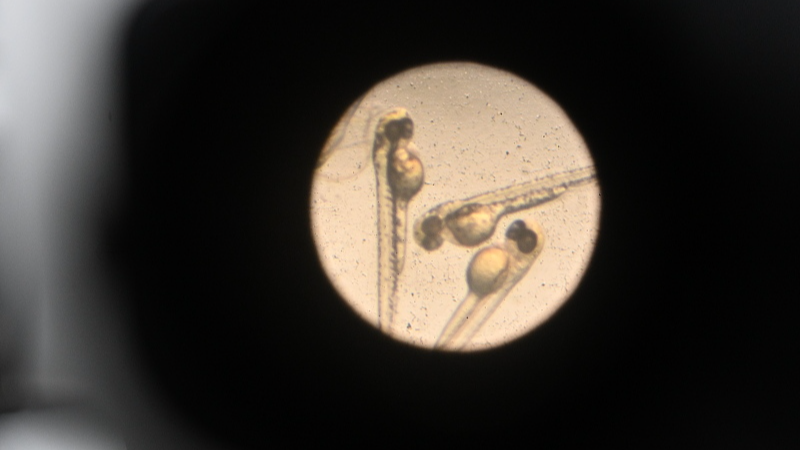
Semi-cloning represents a unique approach to generating individual animals, while zebrafish serve as a key model organism for studying vertebrate development and diseases.

Current technologies have shortcomings or limited performance, according to the Chinese Academy of Sciences (CAS). As a result, the efficient and rapid creation of gene-edited zebrafish models has long been a major bottleneck in the field.

The researchers from the CAS Center for Excellence in Molecular Cell Science used fresh haploid cells at the blastocyst stage to generate fertile semi-cloned zebrafish. After optimization, the success rate increased to around 30%.

Based on haploid blastocyst cell nuclear transfer, this technology yields semi-cloned zebrafish with uniform traits. By performing multiplex gene editing in haploid embryos, it enables one-step generation of donor cells with various genotype combinations and produces both male and female semi-cloned zebrafish.

The findings render the semi-cloning system a valuable platform for zebrafish genetic analysis, said the CAS.

(Cover via VCG)

Source(s): Xinhua News Agency

Original Text (This is the original text for your reference.)

Researchers study zebrafish at the CAS Center for Excellence in Brain Science and Intelligence Technology, Shanghai, December 9, 2025. /VCG

Researchers study zebrafish at the CAS Center for Excellence in Brain Science and Intelligence Technology, Shanghai, December 9, 2025. /VCG

Chinese researchers have developed a novel technology for semi-cloning in zebrafish, according to a recent research article published in the journal Cell Research.

Semi-cloning represents a unique approach to generating individual animals, while zebrafish serve as a key model organism for studying vertebrate development and diseases.

Current technologies have shortcomings or limited performance, according to the Chinese Academy of Sciences (CAS). As a result, the efficient and rapid creation of gene-edited zebrafish models has long been a major bottleneck in the field.

The researchers from the CAS Center for Excellence in Molecular Cell Science used fresh haploid cells at the blastocyst stage to generate fertile semi-cloned zebrafish. After optimization, the success rate increased to around 30%.

Based on haploid blastocyst cell nuclear transfer, this technology yields semi-cloned zebrafish with uniform traits. By performing multiplex gene editing in haploid embryos, it enables one-step generation of donor cells with various genotype combinations and produces both male and female semi-cloned zebrafish.

The findings render the semi-cloning system a valuable platform for zebrafish genetic analysis, said the CAS.

(Cover via VCG)

Source(s): Xinhua News Agency
Comments

    Something to say?

    Login or Sign up for free

    Disclaimer: The translated content is provided by third-party translation service providers, and IKCEST shall not assume any responsibility for the accuracy and legality of the content.
    Translate engine
    Article's language
    English
    中文
    Pусск
    Français
    Español
    العربية
    Português
    Kikongo
    Dutch
    kiswahili
    هَوُسَ
    IsiZulu
    Action
    Related

    Report

    Select your report category *


    Reason *


    By pressing send, your feedback will be used to improve IKCEST. Your privacy will be protected.

    Submit
    Cancel