




 User Center
 My Training Class
 Feedback


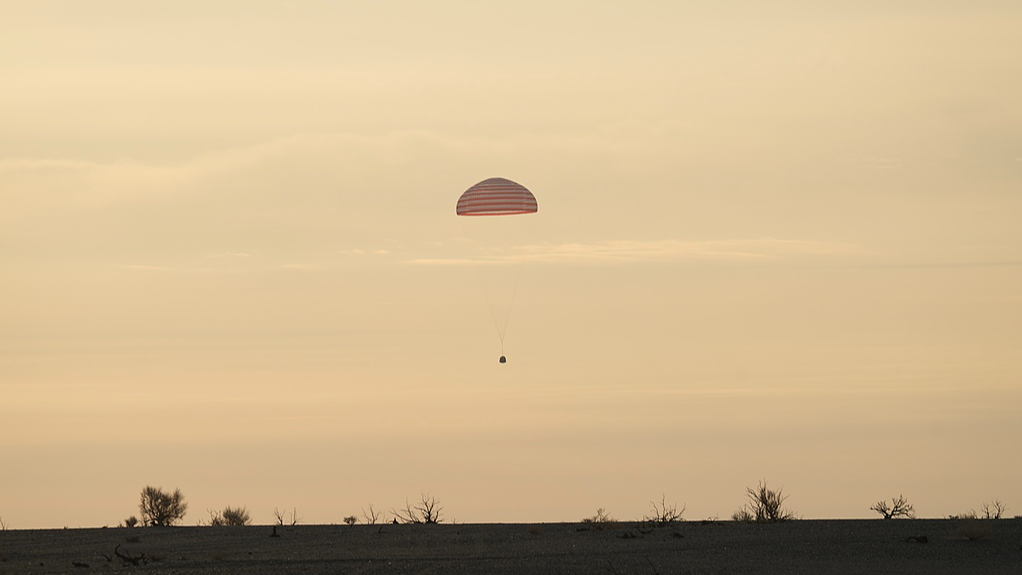
The return capsule of the Shenzhou-20 spaceship at the Dongfeng landing site in north China's Inner Mongolia Autonomous Region, January 19, 2026. /VCG
The return capsule of the debris-hit Shenzhou-20 spaceship landed safely back on Earth on Monday after an extended stay in orbit, with engineers hailing the return as another landmark test passed by the country's space program.
The China Manned Space Agency (CMSA) confirmed the capsule touched down safely at the Dongfeng Landing Site in north China's Inner Mongolia Autonomous Region at 9:34 a.m. on Monday, bringing an end to the extraordinary mission.
Launched last April, Shenzhou-20's planned return was postponed in early November due to concerns over damage caused by a suspected space debris impact, after the CMSA said tiny cracks were found in the Shenzhou-20 return capsule's viewport window. An alternative spacecraft was later used to transport the three Chinese astronauts of the Shenzhou-20 mission safely back to Earth.
Monday's return began shortly after midnight Beijing time, when the spaceship undocked from China's space station and began its descent.
Despite sustaining damage, the capsule withstood temperatures of thousands of degrees Celsius during the re-entry process and successfully touched down on Earth. Initial on-site inspections by ground crew at the landing site confirmed that the return capsule's overall appearance was normal and that the items returned inside were in good condition.
A notable feature of the unprecedented return mission was the absence of any astronauts to manually perform operations during the flight, with key procedures instead being carried out solely by remote commands sent from the ground team.
The CMSA later hailed the space emergency response mission as a "complete success." Engineers said that overcoming this set of challenges marks a key advancement in China's ground-space coordination skills and the country's capacity to handle unexpected situations and ensure the safe and reliable return of spacecraft.
"This is the first uncrewed spacecraft return during the space station's operational phase. Before the mission began, we developed contingency plans for various anomaly scenarios to ensure coordinated and successful operations," said Li Liang, an engineer at the Beijing Aerospace Control Center.
Li also highlighted the overall endurance of the craft, which remained in space over three months longer than anticipated, and the work undertaken by the Shenzhou-21 astronauts, who had arrived at China's space station to take over duties from the Shenzhou-20 crew and who helped to seal and reinforce the capsule as well as ensure it carried a sufficient payload to counter the lack of astronauts aboard.
"Having spent nine months in orbit, making it the longest-serving crewed spacecraft in China's history, Shenzhou-20 also undertook the first uncrewed return during the operational phase of China's space station program," he said. "This uncrewed configuration, combined with the several large payloads the spacecraft carried, resulted in its overall distribution of mass being distinctly different from a standard crewed mission. Therefore, before departing the spacecraft, astronauts needed to carefully balance the onboard payload and maintain the spacecraft's center of mass to ensure stability during return."
Prior to the return mission, the Beijing Aerospace Control Center had reviewed and reconfirmed all flight control plans and contingency measures. Given Shenzhou-20's extended stay in orbit, specialized checks, including platform inspections and engine maintenance, were conducted to fully verify its condition.
The Shenzhou-20 spacecraft spent a total of 270 days in orbit, validating its long-term docking capability. Engineers said follow-up work will also provide an important basis for China's space program to continually refine operating procedures.
"The extended orbital data from this mission is highly valuable and provides critical operational experience. We will conduct a thorough analysis of all data following the suspected space debris event to inform future design and procedural improvements," said Zheng Wei, an engineer from the China Aerospace Science and Technology Corporation.




 Report
 Share
Share





Comments
Something to say?
Login or Sign up for free