

Welcome to the IKCEST
AI prowess redefining business niches
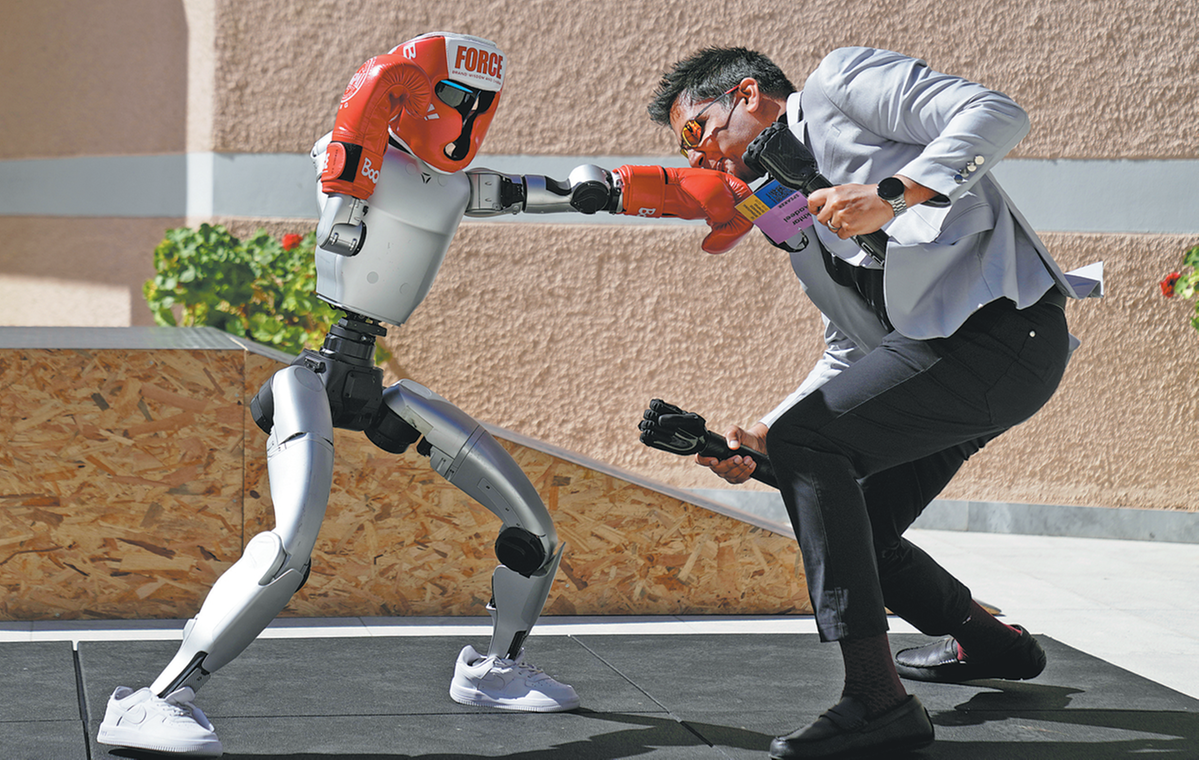
A Unitree G1 robot spars with Aadeel Akhtar, CEO and founder of Psyonic, at the first International Humanoid Olympiad at the Olympic Academy in Olympia, Greece, on Sept 1. THANASSIS STAVRAKIS/AP

In a soundproof recording studio in New York City in the United States, an independent audio producer leans toward a microphone, replaying the same 30-second script again and again. The voice coming through the speakers sounds unmistakably like his own — same timbre, same cadence — but it is not him speaking.

Minutes earlier, he uploaded a short voice sample into an AI tool called MiniMax Audio, developed by a Chinese startup thousands of kilometers away in Shanghai. Within seconds, the system cloned his voice and generated a polished advertising read, ready for delivery.

Half a world away, in Shanghai's Xuhui district, engineers at Mini-Max's research center are watching dashboards light up with real-time feedback from users like him. They are fine-tuning multilingual pronunciation rules, stress patterns and emotional intonation, optimizing a model that now serves users in more than 200 countries and regions.

This quiet, transpacific loop — a US creator using Chinese AI software refined by engineers responding to global demand — captures a broader shift underway in the global technology landscape.

China's artificial intelligence companies are no longer content to compete at home. They are exporting models, platforms and increasingly, entire industrial solutions, reshaping how AI is built, deployed and governed worldwide.

Founded in early 2022, MiniMax spent just over three years turning a self-developed multimodal foundation model from a Shanghai lab project into a global product suite spanning text, audio and video generation. Its trajectory mirrors a broader wave of Chinese AI startups that, after years of intense domestic competition, are now pushing outward.

By late 2025, that wave reached a symbolic milestone. From Manus — acquired by Meta for billions of dollars — to Beijing-based Zhipu AI and MiniMax, which both passed Hong Kong stock exchange listing hearings, China's latest generation of AI entrepreneurs had begun to "come ashore" financially.


1 2 3 Next   >>|

Original Text (This is the original text for your reference.)

A Unitree G1 robot spars with Aadeel Akhtar, CEO and founder of Psyonic, at the first International Humanoid Olympiad at the Olympic Academy in Olympia, Greece, on Sept 1. THANASSIS STAVRAKIS/AP

In a soundproof recording studio in New York City in the United States, an independent audio producer leans toward a microphone, replaying the same 30-second script again and again. The voice coming through the speakers sounds unmistakably like his own — same timbre, same cadence — but it is not him speaking.

Minutes earlier, he uploaded a short voice sample into an AI tool called MiniMax Audio, developed by a Chinese startup thousands of kilometers away in Shanghai. Within seconds, the system cloned his voice and generated a polished advertising read, ready for delivery.

Half a world away, in Shanghai's Xuhui district, engineers at Mini-Max's research center are watching dashboards light up with real-time feedback from users like him. They are fine-tuning multilingual pronunciation rules, stress patterns and emotional intonation, optimizing a model that now serves users in more than 200 countries and regions.

This quiet, transpacific loop — a US creator using Chinese AI software refined by engineers responding to global demand — captures a broader shift underway in the global technology landscape.

China's artificial intelligence companies are no longer content to compete at home. They are exporting models, platforms and increasingly, entire industrial solutions, reshaping how AI is built, deployed and governed worldwide.

Founded in early 2022, MiniMax spent just over three years turning a self-developed multimodal foundation model from a Shanghai lab project into a global product suite spanning text, audio and video generation. Its trajectory mirrors a broader wave of Chinese AI startups that, after years of intense domestic competition, are now pushing outward.

By late 2025, that wave reached a symbolic milestone. From Manus — acquired by Meta for billions of dollars — to Beijing-based Zhipu AI and MiniMax, which both passed Hong Kong stock exchange listing hearings, China's latest generation of AI entrepreneurs had begun to "come ashore" financially.

1 2 3 Next   >>|
Comments

    Something to say?

    Login or Sign up for free

    Disclaimer: The translated content is provided by third-party translation service providers, and IKCEST shall not assume any responsibility for the accuracy and legality of the content.
    Translate engine
    Article's language
    English
    中文
    Pусск
    Français
    Español
    العربية
    Português
    Kikongo
    Dutch
    kiswahili
    هَوُسَ
    IsiZulu
    Action
    Related

    Report

    Select your report category *


    Reason *


    By pressing send, your feedback will be used to improve IKCEST. Your privacy will be protected.

    Submit
    Cancel