

Welcome to the IKCEST
China sets 2027 goal for breakthrough in core AI tech
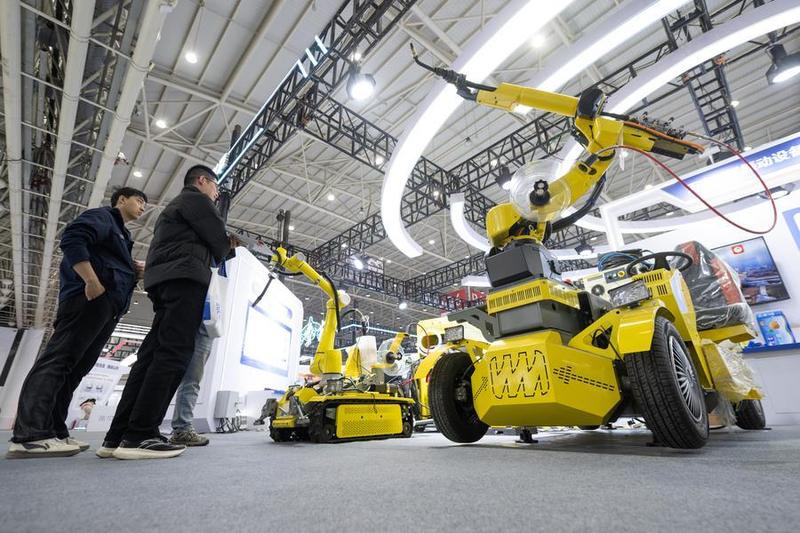
People learn about self-propelled welding robots at the 2025 Wuhan International Industrial Design Expo in Wuhan, Central China's Hubei province, Dec 12, 2025. [Photo/Xinhua]

Eight Chinese government departments, led by the Ministry of Industry and Information Technology, unveiled a plan on Wednesday to integrate artificial intelligence with manufacturing, aiming to secure a reliable supply of core AI technologies by 2027, while ensuring that China remains among the global leaders in both the scale and capabilities of the industry.

The "AI plus Manufacturing" initiative outlines a comprehensive strategy to strengthen China’s AI ecosystem, with a focus on independent innovation and industrial empowerment.

A key priority will be enhancing AI computing power, including promoting the coordinated development of software and hardware for AI chips. Support will be given to breakthroughs in high-end training chips, edge-side inference chips, AI servers, high-speed interconnection and intelligent computing cloud operating systems.

By 2027, China aims to implement three to five general-purpose large language AI models in manufacturing, develop specialized industry-specific models, create 100 high-quality industrial datasets, and promote 500 key application scenarios.

The plan also emphasizes enterprise cultivation, with a target of fostering two to three globally influential ecosystem-leading firms, along with a group of specialized and innovative small and medium-sized enterprises. It intends to nurture a batch of service providers skilled in both AI and industry knowledge, and to recognize 1,000 benchmark enterprises.

Efforts will also be made to build a world-leading open-source ecosystem and improve security governance, contributing "China’s solutions" to global AI development, the plan said.

In addition, the initiative highlights accelerated industrialization and commercialization of new terminals such as AR and VR wearables and brain-computer interfaces, focusing on key scenarios like industrial inspection and telemedicine.

It also promotes innovation in embodied intelligent products, including the construction of pilot bases and training grounds for humanoid robots, the establishment of benchmark production lines, and their early application in typical manufacturing environments.

The move signals China’s strategic push to harness AI for industrial upgrading while reinforcing technological self-sufficiency in critical sectors.


Original Text (This is the original text for your reference.)

People learn about self-propelled welding robots at the 2025 Wuhan International Industrial Design Expo in Wuhan, Central China's Hubei province, Dec 12, 2025. [Photo/Xinhua]

Eight Chinese government departments, led by the Ministry of Industry and Information Technology, unveiled a plan on Wednesday to integrate artificial intelligence with manufacturing, aiming to secure a reliable supply of core AI technologies by 2027, while ensuring that China remains among the global leaders in both the scale and capabilities of the industry.

The "AI plus Manufacturing" initiative outlines a comprehensive strategy to strengthen China’s AI ecosystem, with a focus on independent innovation and industrial empowerment.

A key priority will be enhancing AI computing power, including promoting the coordinated development of software and hardware for AI chips. Support will be given to breakthroughs in high-end training chips, edge-side inference chips, AI servers, high-speed interconnection and intelligent computing cloud operating systems.

By 2027, China aims to implement three to five general-purpose large language AI models in manufacturing, develop specialized industry-specific models, create 100 high-quality industrial datasets, and promote 500 key application scenarios.

The plan also emphasizes enterprise cultivation, with a target of fostering two to three globally influential ecosystem-leading firms, along with a group of specialized and innovative small and medium-sized enterprises. It intends to nurture a batch of service providers skilled in both AI and industry knowledge, and to recognize 1,000 benchmark enterprises.

Efforts will also be made to build a world-leading open-source ecosystem and improve security governance, contributing "China’s solutions" to global AI development, the plan said.

In addition, the initiative highlights accelerated industrialization and commercialization of new terminals such as AR and VR wearables and brain-computer interfaces, focusing on key scenarios like industrial inspection and telemedicine.

It also promotes innovation in embodied intelligent products, including the construction of pilot bases and training grounds for humanoid robots, the establishment of benchmark production lines, and their early application in typical manufacturing environments.

The move signals China’s strategic push to harness AI for industrial upgrading while reinforcing technological self-sufficiency in critical sectors.

Comments

    Something to say?

    Login or Sign up for free

    Disclaimer: The translated content is provided by third-party translation service providers, and IKCEST shall not assume any responsibility for the accuracy and legality of the content.
    Translate engine
    Article's language
    English
    中文
    Pусск
    Français
    Español
    العربية
    Português
    Kikongo
    Dutch
    kiswahili
    هَوُسَ
    IsiZulu
    Action
    Related

    Report

    Select your report category *


    Reason *


    By pressing send, your feedback will be used to improve IKCEST. Your privacy will be protected.

    Submit
    Cancel