

Welcome to the IKCEST
AI thrust to foster new growth drivers
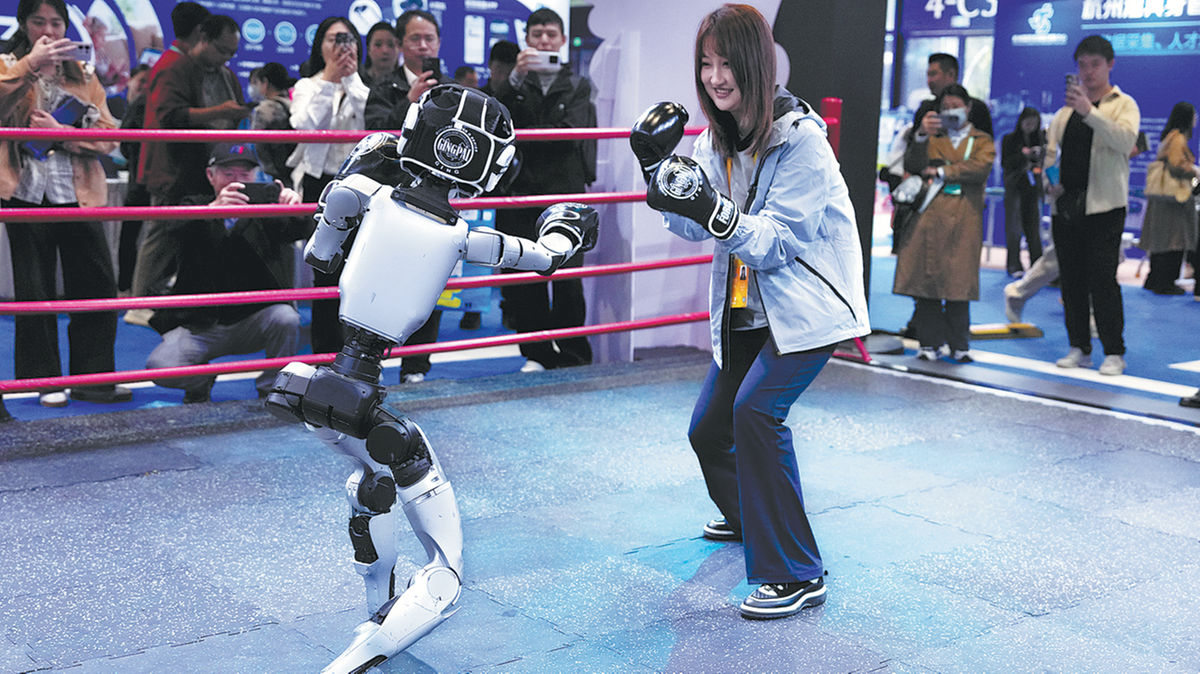
A participant boxes with a humanoid robot from Unitree Robotics during the 2025 World Internet Conference Wuzhen Summit in Wuzhen, Zhejiang province, on Nov 6. HUANG ZONGZHI/XINHUA

China's resolve to deeply integrate artificial intelligence into a wide range of fields will help the country foster new growth drivers and provide strong impetus for high-quality economic development, solidifying its position as a global innovation powerhouse, said company executives and industry experts.

As China recognizes AI as an essential tool in nurturing new quality productive forces, the application of AI will promote the transformation and upgrading of traditional industries as well as help the country gain the edge amid increasingly fierce international competition.

China's AI industry continues to demonstrate strong momentum. The country holds the largest number of AI-related patents worldwide, accounting for 60 percent of the global total, according to a report by the Chinese Academy of Cyberspace Studies.

Data from the China Academy of Information and Communications Technology show that the nation has maintained its position as a global leader in AI innovation and released 1,509 AI models to date, ranking first among the 3,755 models launched globally until now.

Wu Yongming, CEO of Chinese tech heavyweight Alibaba Group, said the company is increasing investment in AI infrastructure and remains committed to open-sourcing its large language models, empowering developers worldwide to build transformative AI applications.

Wu made the remarks at the 2025 World Internet Conference Wuzhen Summit, which was held in Wuzhen, Zhejiang province, last month. Alibaba has announced plans to invest more than 380 billion yuan ($53.8 billion) in building cloud and AI hardware infrastructure over the next three years.

Wu said the speed of AI industry development and the demand for AI infrastructure have far outpaced expectations.

"In the future, large AI models will be deeply integrated into a wide range of devices, functioning like operating systems — equipped with persistent memory, seamless cloud-edge coordination and the ability to continuously evolve."


1 2 3 Next   >>|

Original Text (This is the original text for your reference.)

A participant boxes with a humanoid robot from Unitree Robotics during the 2025 World Internet Conference Wuzhen Summit in Wuzhen, Zhejiang province, on Nov 6. HUANG ZONGZHI/XINHUA

China's resolve to deeply integrate artificial intelligence into a wide range of fields will help the country foster new growth drivers and provide strong impetus for high-quality economic development, solidifying its position as a global innovation powerhouse, said company executives and industry experts.

As China recognizes AI as an essential tool in nurturing new quality productive forces, the application of AI will promote the transformation and upgrading of traditional industries as well as help the country gain the edge amid increasingly fierce international competition.

China's AI industry continues to demonstrate strong momentum. The country holds the largest number of AI-related patents worldwide, accounting for 60 percent of the global total, according to a report by the Chinese Academy of Cyberspace Studies.

Data from the China Academy of Information and Communications Technology show that the nation has maintained its position as a global leader in AI innovation and released 1,509 AI models to date, ranking first among the 3,755 models launched globally until now.

Wu Yongming, CEO of Chinese tech heavyweight Alibaba Group, said the company is increasing investment in AI infrastructure and remains committed to open-sourcing its large language models, empowering developers worldwide to build transformative AI applications.

Wu made the remarks at the 2025 World Internet Conference Wuzhen Summit, which was held in Wuzhen, Zhejiang province, last month. Alibaba has announced plans to invest more than 380 billion yuan ($53.8 billion) in building cloud and AI hardware infrastructure over the next three years.

Wu said the speed of AI industry development and the demand for AI infrastructure have far outpaced expectations.

"In the future, large AI models will be deeply integrated into a wide range of devices, functioning like operating systems — equipped with persistent memory, seamless cloud-edge coordination and the ability to continuously evolve."

1 2 3 Next   >>|
Comments

    Something to say?

    Login or Sign up for free

    Disclaimer: The translated content is provided by third-party translation service providers, and IKCEST shall not assume any responsibility for the accuracy and legality of the content.
    Translate engine
    Article's language
    English
    中文
    Pусск
    Français
    Español
    العربية
    Português
    Kikongo
    Dutch
    kiswahili
    هَوُسَ
    IsiZulu
    Action
    Related

    Report

    Select your report category *


    Reason *


    By pressing send, your feedback will be used to improve IKCEST. Your privacy will be protected.

    Submit
    Cancel